West Campus clinic patients, families and staff were surprised earlier this month when eight superheroes and animated characters swooped in for a visit.

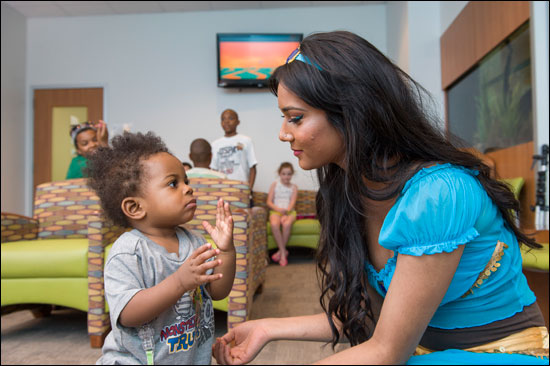
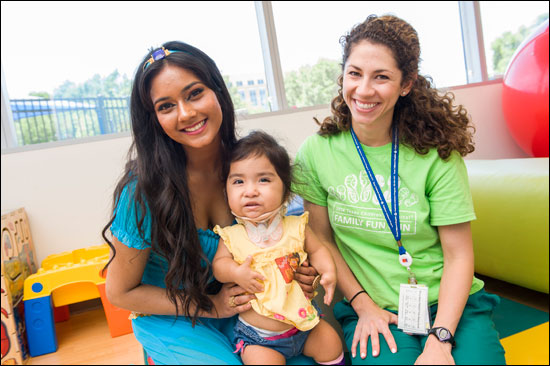
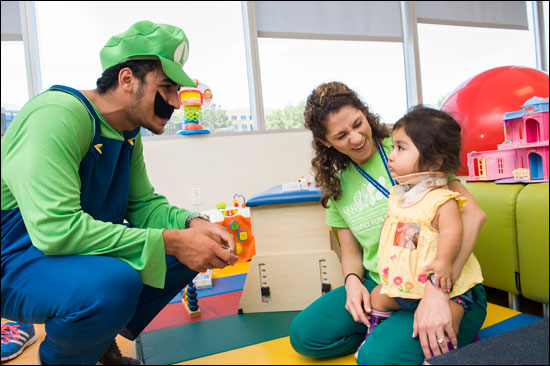
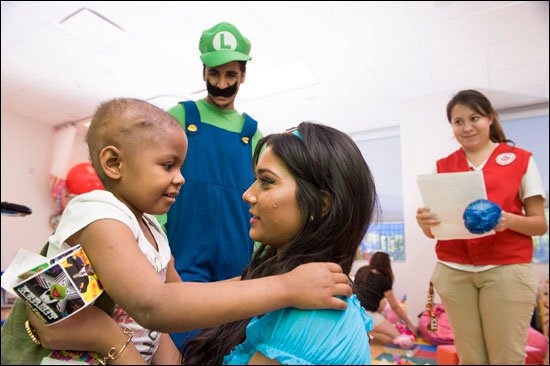
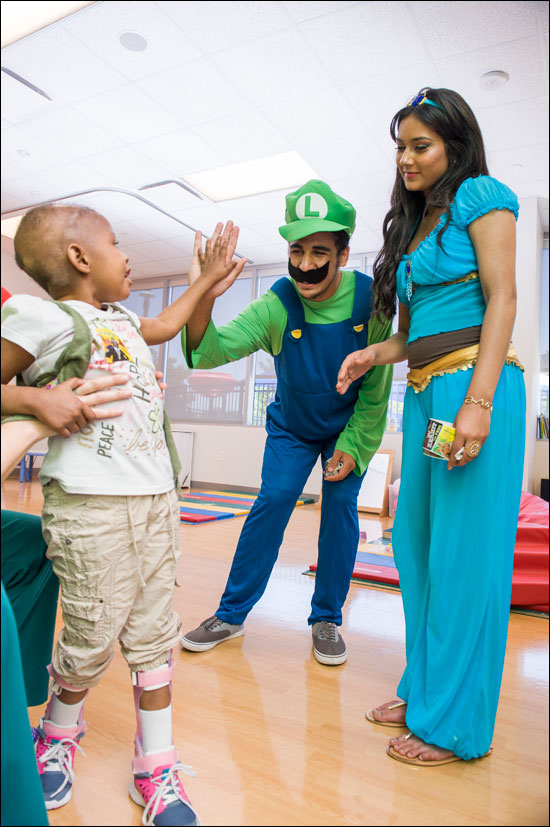
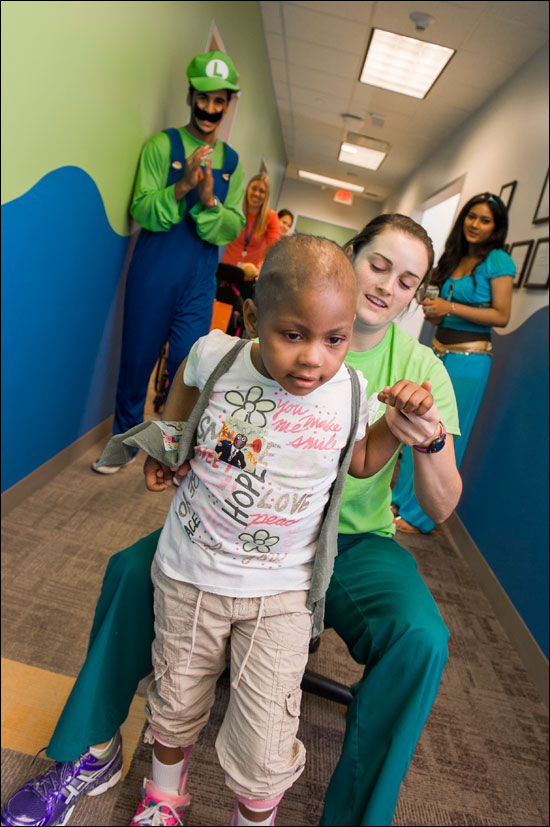

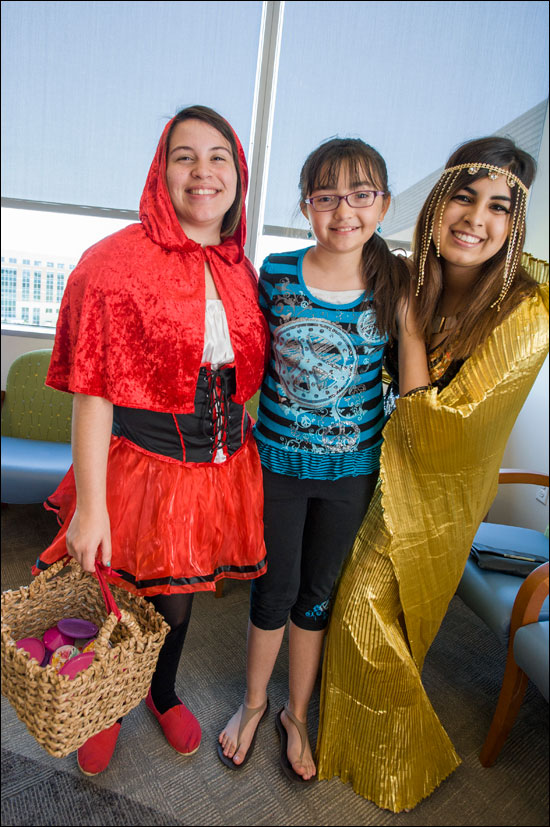
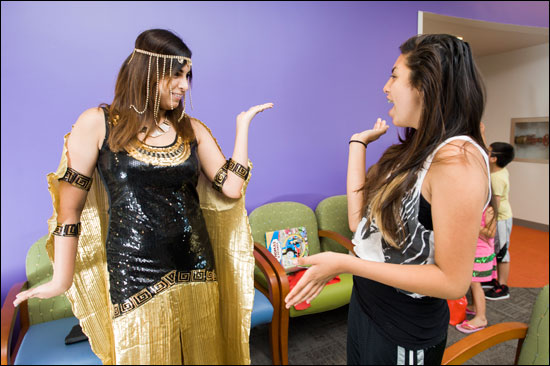
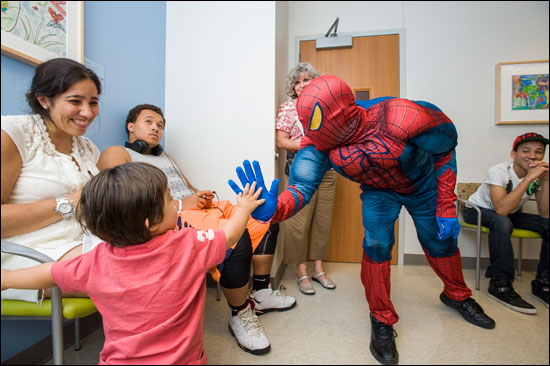



West Campus clinic patients, families and staff were surprised earlier this month when eight superheroes and animated characters swooped in for a visit.

By Julie Griffith
My role at Texas Children’s is to develop programs and services that support our employees in achieving optimal health and well-being. From the moment I learned I was expecting, I felt a sense of personal responsibility to provide the best possible environment for my baby to flourish. I have outlined the key dimensions of wellness that I have focused on throughout my pregnancy.
Stock up on sleep
I cherish my sleep! I am a solid eight hours of sleep person. Yes, I am aware that I am in for a rude awakening once the baby arrives! The biggest piece of advice I have been hearing lately is to “stock up on my sleep now while I still can.”
Adequate hours and quality sleep is essential for our physical, mental and emotional well-being, and this is especially true for pregnant women. I have made a point to establish a bed time routine in a restful environment that is cool and dark. Experts also say that limiting screen time and keeping electronics out of the bedroom are beneficial in improving your sleep quality. Although I don’t always abide by that rule, I do try to make it the norm. I will give some credit to my body-size pregnancy pillow that has come in handy as my belly has grown.
Eating well
After the realization of being pregnant sank in, I felt that eating a nutritious and well-balanced diet as one of the greatest gifts I could give to my growing baby. The food we eat affects how our bodies work, how we feel and heal, and how we maintain our energy. It also determines the basic nutritional health that our children are born with, and provides a model for their eating habits during childhood and beyond. I can’t say that my pregnancy diet has been flawless, but I focused on maintaining a wholesome diet of lean proteins, lots of fresh fruits and vegetables, eating a healthy breakfast every day and moderately indulging (usually on chocolate) on occasion. The USDA Choose My Plate site is a wonderful resource with meal plans, snack ideas, and weight gain guidelines for pregnant women.
Raise your water glass
It is estimated that pregnant women’s blood volume increases by as much as 50 percent. Water helps transportation and absorption of essential nutrients into our cells and is essential to meet this growing demand. It’s these nutrient-rich blood cells that reach the placenta and ultimately the baby, all with the help of good old fashioned H2O. It was recently described to me that “drinking water is like giving your cells a bath.” I now visualize every sip of water I take as an opportunity to cleanse our systems!
 Let’s get physical
Recently, Alysia Montaño made headlines as she ran in the 800 meters race at the US Track and Field Championship while 8 months pregnant with the support of both her midwife and doctor. Although the media response was mostly positive it raised questions about exercising during pregnancy. After discussing this with a health care provider, it is generally considered safe to continue your pre-pregnancy exercise routine and adjust appropriately over time. My personal goal was not to run a marathon or 100 percent commit to my typical workout routine, but to be active most days of the week through exercise classes, walking and prenatal yoga and be in tune with my body as my pregnancy progressed.
Don’t leave before you leave
Last summer I read Sheryl Sandberg’s book “Lean In” and the chapter “Don’t Leave Before You Leave” has been a driving force throughout my pregnancy and leading up to my maternity leave. Sandberg said women start thinking about balancing work and family life before it is truly necessary and often scale back on job responsibilities in preparation for having children. Integrating my new family and career is very important to me. I have no doubt that my life priorities will shift and that returning to work will be challenging. However, by accelerating or “leaning into” my career now with such a dramatic life change on the horizon, I feel that I will return to work that is both professionally and personally rewarding and that will make for a smoother transition.

Representatives from Texas Children’s Hospital are joining children’s hospitals from across the nation in Washington, D.C.this week for the annual Children’s Hospital Association (CHA) Family Advocacy Day. CHA recently launched Speak Now for Kids, a grassroots initiative to advocate for medically complex children.
Dr. Jennifer Arnold, neonatologist and medical director of Texas Children’s Simulation Center, along with her husband, Bill Klein, and their two children, Will and Zoey, is representing Texas Children’s Hospital at the event. Arnold provides the insightful perspective of a physician, former patient and a mother of two children with medical complexities.
“Everyone, including our policymakers, needs to know the best place for children with complex medical conditions is a children’s hospital, where experienced specialty care is available for their needs,” Arnold said. “It ultimately gives children the best chance at a healthy and happy life.”
Family Advocacy Day convenes hospital representatives and their patient families to speak to their members of Congress about supporting legislation to create pediatric centers of excellence at children’s hospitals to care for the most vulnerable patients: medically complex children on Medicaid. The legislation – titled “Advancing Care for Exceptional Kids Act” (or ACE Kids Act) – will ensure that children are able to receive the care they need from a center equipped to provide comprehensive care, even if the hospital is in another state.
Arnold, her family and families from other children’s hospitals are meeting with members of Congress to advocate for Medicaid reform for children with medical complexities, the reauthorization of the Children’s Health Insurance Program (CHIP) and funding to train pediatric residents.
“It is my love as a parent, my duty as a physician and my experience as a patient which compels me to raise awareness for this important issue,” Arnold said.
The families speaking in Washington, D.C., this week represent the voices of the thousands of children being treated at centers of excellence like Texas Children’s Hospital every day. As a Texas Children’s employee, you can help spread the message about why children’s hospitals are the best place for kids with complex medical.
5 ways you can Speak Now for Kids:

It’s been a busy month for Texas Children’s Urgent Care in Katy, but that’s putting it lightly. Opened since May 13, the new after-hours clinic at 9727 Spring Green Blvd., in Cinco Ranch, has treated more than 600 patients in the first month, exceeding expectations.
“The large volume of patients that come to our clinic demonstrates the growing need for expert pediatric urgent care after hours,” said Randall Wright, executive vice president of Texas Children’s Hospital. “We are committed to meeting that need and continuing to provide superior quality service to our patients and their families in the Houston community.”
Texas Children’s Urgent Care is open to all patients, not just patients of Texas Children’s Pediatrics (TCP). Of the children who come to our clinic, 60 percent are TCP patients, five percent are new patients to Texas Children’s, and 40 percent are referrals from non-TCP pediatricians and those who have driven by our facility after seeing our signage.
Our urgent care centers are located right in your neighborhood, making it easier and convenient for your children to receive immediate, after-hours care for minor injuries and illnesses when most pediatrician offices are closed and when symptoms aren’t serious enough to warrant an emergency room visit. When patients and their families come here, they don’t have to wait very long. The patient turnaround time from walk-in to walk-out is less than 45 minutes.

Texas Children’s Urgent Care is open Mondays to Fridays from 4:30 p.m. to 11 p.m. and Saturday and Sundays from noon to 8 p.m. Patients receive prompt care for minor health issues such as the flu, strep throat, asthma, fever, minor burns, ear infections, allergic reactions, sprains and more. Patients who need fracture care and splinting, IV fluids, lab services, laceration repair and x-rays may also receive treatment at Texas Children’s Urgent Care.
[Click here to learn the difference between urgent care versus emergency care.]While most urgent care clinics in Houston are primarily adult-focused, Texas Children’s Urgent Care is staffed by board-certified pediatricians and nurses specifically trained in pediatrics, to ensure every single child who walks through our doors is getting the best specialized care possible.
To complement the services at our Cinco Ranch location, a second Texas Children’s Urgent Care clinic will open in Houston’s Town & Country area (12850 Memorial Drive), in late July.
“We are excited to bring this expert urgent care model to the Houston community,” says Dr. Gary Gerlacher, Texas Children’s Urgent Care lead physician. “In my experience, I’ve seen firsthand how the urgent care setting has truly helped fill a void in treatment for children and their families.”
Texas Children’s Urgent Care accepts major insurance plans, including Medicaid, and has self-pay rates. Rates are significantly less than emergency center charges, and there are no hospital fees.
Click here for a complete list of insurance plans and to learn more about Texas Children’s Urgent Care.

Texas Children’s Hospital reached a milestone in early June when the 100th surgery using a Da Vinci Si robot was performed.
Not only was this an achievement for the Department of Surgery and the Pavilion for Women but it was also a cause for celebration because its usage sets the standard at Texas Children’s Hospital for pediatric minimally invasive reconstructive surgery, according to Dr. Chester Koh, director, Pediatric Robotic Surgery Program. The da Vinci Si robot enables the surgeon to use fully articulating instruments to operate on delicate structures and limited space in a child’s anatomy. Its magnified 3D high-definition vision system and special wristed instruments bend and rotate far greater than the human wrist yet the surgeon is in complete control.
Where previously surgeons needed to make large incisions with their hands and a scalpel to reach internal organs such as the kidney, they can now use the robot for surgical maneuvers through tiny incisions. Pyeloplasty is the most common pediatric procedure performed with the robot. During this urologic procedure, surgeons correct a blockage or narrowing of the ureter where it leaves the kidney. Children benefit from robotic surgery because they have less post-operative pain with a corresponding decreased need for pain medications, faster recovery times and shorter hospital stays.
With the arrival of Dr. Patricio Gargollo, as director of the Complex Urogenital Reconstruction Program, the Pediatric Urology division now benefits from two pediatric surgeons who between them have performed more than 500 robotic surgery cases. Gargollo’s experience brings advanced robotic surgery skills to the team to treat patients who need complex reconstructive procedures such as bladder augmentation, continent catheterizable channels and bladder neck reconstruction.
Women who are patients at the Pavilion for Women benefit from robotic surgery also. “Robotic surgery benefits women who have certain procedures because the surgeon can make smaller incisions, which means a faster recovery time and better cosmetic appearance after surgery,” said obstetrician Dr. David Zepeda.
Surgeons from Pediatric Urology and Pediatric Surgery at Texas Children’s Hospital and Obstetrics and Gynecology at the Pavilion for Women currently make use of the da Vinci Si robot.
The robotic surgery team includes:
Department of Surgery:
Department of Obstetrics & Gynecology:
Having surpassed the 100th case at Texas Children’s Hospital, Koh and the team look forward to future milestones for the program.

While thousands flock to Brazil for the World Cup games, many health care workers are worried about more than which team will take home the trophy. NTDs like Dengue and Chagas are plaguing the citizens of Brazil – putting a definite damper on the spirit of the games.
“The theme of the 2014 FIFA World Cup Brazil is ‘all in one rhythm.’ So far that rhythm could leave behind millions of Chagas disease sufferers in the Americas,” said Dr. Peter Hotez, Texas Children’s Hospital endowed chair in Tropical Pediatrics. Hotez’ recent article about Chagas disease, which is a leading cause of severe and life-threatening heart disease in the Americas, was published on HuffPost.com, and brings to light the fact that more than 1 million people in Brazil suffer from Chagas.
Also of great concern is the surge in cases of dengue fever in Brazil’s largest city, Sao Paulo. Certain strains of the disease, which is carried by female mosquitoes, can be fatal and there is currently no treatment or vaccine. Despite government efforts as of late to control mosquitos with powerful pesticides, the dengue epidemic is sweeping through Brazil, and many worry that international visitors could contract the disease and bring it back to their home countries.
“Several multinational pharmaceutical companies, even Brazil’s Instituto Butantan, are working to make a prototype dengue vaccine, but these will not be ready in time for the World Cup,” said Hotez. “In the meantime, measures aimed at mosquito control and personal protective measures against mosquitos are all that are available.”
Back here in Houston, fear of dengue spreading to the U.S. feels all too real, especially in light of evidence found by our own Dr. Kristy Murray, associate professor of pediatric tropical medicine at Baylor College of Medicine and Texas Children’s Hospital, which suggests that dengue has re-emerged in Houston. Murray and her team investigated the possibility that dengue might be in Houston because the area has the type of mosquitoes known to carry the virus and a dense population full of frequent travelers south of the border. But the study, published this past fall, found that most of the infections were transmitted in Houston.
“This study shows that Houston may be at risk of an outbreak, that people need to be on the lookout,” said Murray.
Beyond NTDs like dengue and Chagas, many in the health care field see Brazil’s hosting of the World Cup as a time to put the spotlight on the various diseases that impact (and often kill) children in Brazil and the Americas – some as simple as diarrhea and pneumonia, which can be prevented through vaccines.
The Global Alliance for Vaccines and Immunization (GAVI) launched a World Cup-themed report last month, designed to draw parallels between the shots, saves and goals made on the field and the shots (vaccines) needed to save lives and help achieve GAVI’s big goals. The report, “Going for Goal: Immunization and the Case for GAVI,” looks at each team playing in this summer’s World Cup (as well as a few others who didn’t make the cut), analyzing their countries’ contributions to global immunization efforts and offering up “pundit’s verdicts” for their future performance.
So while sports fans may be fired up whenever their team scores over the next few weeks, here at Texas Children’s, we’ll be cheering on organizations that are working to ensure children in Brazil, and everywhere, get the vaccines they need – a goal worth celebrating.
Those who are traveling to Brazil this summer, or want to know more about the diseases mentioned in this article, should visit the Travel Clinic at Texas Children’s.

Q&A: Annette Gabonay Guzman, April – June 2014 Leader
Your name, title and department. How long have you worked here?
Annette Gabonay Guzman, manager of Therapy Department at Texas Children’s Health Centers – Sugar Land. I have been the manager for seven years and have been a Texas Children’s Hospital employee for nine years.
What month are you Super Star for?
April-June 2014
Tell us how you found out you won a Super Star award.
I walked into a “Health Center concerns” meeting only to find out that it was a surprise meeting for me to let me know that I was awarded Super Star Leader.
What does it mean to be recognized for the hard work you do?
I feel appreciated and valued for the work that I do. It is a great honor to be recognized for it by my peers.
What do you think makes someone at Texas Children’s a super star?
I think that being able to guide, inspire and encourage others to grow and learn and having the ability to set an example and be followed makes someone at Texas Children’s a Super Star Leader.
What is your motivation for going above and beyond every day at work?
The patients and their families are my motivation for going above and beyond every day at work. I want to provide excellent customer service, and I strive for the Therapy Department to provide the best care possible.
What is the best thing about working at Texas Children’s?
The best thing about working at Texas Children’s is working with my team of employees in the Therapy Department. They work very hard, have great collaboration and make work fun for the team and for all of the patients.
Anything else you want to share?
I am very thankful and humbled to have been given the Super Star Leader award, and I greatly appreciate it.