September 3, 2014

9414TheWomensPlace640

Hormonal changes during and after pregnancy may trigger depression in some women. In fact, between 10 and 15 percent of pregnant women and new mothers may experience some symptoms of depression. But their condition can be far more than simply feeling “blue” or “down.” For many, it can have a debilitating effect on their health, their family, their careers and their relationships.

To address the need for earlier screening and treatment of maternal depression, the Texas Children’s Pavilion for Women launched a pilot program in May to screen patients multiple times throughout their pregnancy and postpartum period. The effort is part of the Women’s Mental Health Delivery System Reform Incentive Payments (DSRIP) program, focusing on expanded access to health care services.

“Our goal is to identify women with maternal depression as soon as possible and get them into care because maternal depression is treatable,” said Dr. Lucy Puryear, medical director of The Women’s Place – Center for Reproductive Psychiatry and Baylor College of Medicine psychiatrist, who oversees the program. “How we deal with this can have a profound impact not only on the physical and emotional well-being of the mother, but on the life of the child and the family overall.”

As part of the program, women are screened for maternal depression using the Edinburgh Postnatal Depression Scale multiple times throughout their pregnancy (during the first and third trimesters) and postpartum (at two weeks in the pediatrician’s office and at six weeks by their obstetrician), and those requiring follow-up mental health services are referred for care.

“Our overriding goal is to learn from the patients we’re currently screening in order to develop a model for the early diagnosis and treatment of maternal depression using several combined strategies,” said Dr. Puryear. “Texas Children’s Pavilion for Women is uniquely positioned to oversee this project because of the unique Reproductive Psychiatry program and faculty at Baylor College of Medicine.”

Dr. Lisa Valentine, a Baylor College of Medicine psychiatrist hired to treat patients as part of this program, practices at The Women’s Place at the Pavilion for Women, The Center for Children and Women at Greenspoint and at Pearland Ob-Gyn. Two Texas Children’s Pediatrics practices, Pearland and Shadow Creek Ranch, are serving as pilot sites for the project. Providers and staff at these pilot sites have been trained to implement standardized screening and referral.

At Texas Children’s Pediatrics Pearland, every new mother is screened for postpartum depression at the initial well-child visit, which occurs approximately two weeks postpartum, referring those needing services. Referrals are processed quickly and most patients are seen within seven days of being screened. Select providers at Texas Children’s Pediatrics Shadow Creek Ranch have also begun standardized screening.

Future plans focus on educating and training staff at obstetric clinics and additional pediatric clinics to implement standardized screening and referral; adding additional providers, including a psychiatrist, therapist and social worker; and expanding to additional sites with the intent of integrating maternal mental health services where women are already seeking treatment.

9414BWNICU640

By Dr. Charles Hankins

As a Texas Children’s neonatologist, I have treated many premature and critically-ill infants in the Neonatal Intensive Care Unit (NICU). When babies are born prematurely, their lungs and other organs are still developing. They are entering the most critical stage of their young lives. Their parents entrust their newborns to us to provide the highest level of care possible.

Our mission at Texas Children’s Hospital has always been to build a healthy community of children. In some cases, this begins in premature and critically-ill infants. To achieve the best neonatal outcomes, Texas Children’s has partnered with community NICUs in the Greater Houston area to ensure these patients receive the right care at the right time and in the right place.

As chief medical officer for Texas Children’s Hospital West Campus, I serve as the primary medical liaison to community physicians and work closely with them to expand access to patient care in the community setting, which is particularly important for the families of our NICU patients.

With a commitment to family-centered care, every effort is made to keep these infants close to their families in the community. Texas Children’s provides these local NICUs with administrative and clinical support, giving patients access to the latest treatments available in neonatal and pediatric care, state-of-the-art equipment and pediatric subspecialists.

If a child is born in one of the community hospitals and needs care offered only in a Level IV NICU, that baby is transferred immediately to our main campus at Texas Children’s Newborn Center, ranked No. 2 in the nation. When these babies graduate to a lower level NICU, the family can request transfer back to their community hospital and maintain the continuity of care which is so vital to helping these newborns thrive.

Texas Children’s is proud to work with these hospitals to provide high-quality care to newborns:

  • Houston Methodist West Hospital
  • Houston Methodist Willowbrook Hospital
  • Houston Methodist San Jacinto Hospital
  • Houston Methodist
  • St. Joseph Medical Center
  • CHI St. Luke’s Health – The Woodlands Hospital
  • CHI St. Luke’s Health – The Vintage Hospital

More than 2,000 NICU infants are cared for each year at Texas Children’s Newborn Center, making us one of the largest, most experienced NICUs in the country. Partnering with community NICUs in the Greater Houston area will ensure our critically-ill babies receive high-quality care, while helping us carry out our mission of creating a community of healthy children.

9414ART550.pg

The 2014 Annual Required Training (ART) course will be live in Decision Critical from Tuesday, September 2, to Tuesday, September 30. All employees, contractors, volunteers, etc. will have until September 30, or earlier at the discretion of their leader, to complete the course to satisfy ART requirements. The completion goal is 100 percent across the organization.

This year, in an effort to simplify the process for employees, the ART course and test have been combined. What this means is that in order to receive credit for ART, you must first review the course slides and complete the module quizzes before advancing to the Acknowledgements section. There will not be a separately graded test this year as in previous years. Your completion of the Acknowledgements section will be your official record of completion.

What is the purpose of ART?
Joint Commission and OSHA require that staff renew their knowledge on an annual basis regarding key components such as: Patient Safety, Bloodborne Pathogens, Hand Hygiene, Diversity and several other important topics. Texas Children’s, in keeping with HIPAA guidelines, also requires staff to review their knowledge regarding Privacy, Compliance, and Information Security to ensure that Texas Children’s continues to sustain a safe and ethical environment in which to work and receive care.

Who is exempt from ART?

All workforce members are required to complete ART except for:

  • Texas Children’s new employees (including Texas Children’s physicians) who were hired after January 1, 2014.
  • Physicians, residents, fellows, dentists, podiatrists and licensed Ph.D. Psychologists not employed by Texas Children’s.

To access the course follow the steps below:

  1. Click on the ‘Annual Required Training / Decision Critical’ link on the Connect homepage under the ‘Quick Links’ heading.
  2. Log-in to Decision Critical.
  3. Click on the ‘Continue’ box.
  4. Click on ‘My Training Plan’.
  5. Find the course title:
    • 2014 Annual Required Training
  6. Click on the ‘Online Course’ link to launch the course.
August 26, 2014

82714drlotzechallenge640

It wasn’t a typical Monday morning for Dr. Timothy Lotze, a neurologist at Texas Children’s. Besides making his usual hospital rounds to see patients, Lotze paid a visit to 14-year old Joseph Garza’s room. But, this visit was extra special.

Trading in his white lab coat for a comfy red T-shirt, Lotze participated in the Ice Bucket Challenge to help raise money and awareness for amyotrophic lateral sclerosis (ALS), a neurodegenerative disease that severely impacts a person’s ability to move.

Lotze accepted the challenge from Texas Children’s Muscular Dystrophy Association representative Dalia Deleon on behalf of Garza, who suffers from an extremely rare form of pediatric ALS.

View the video:

“I am so grateful to Dr. Lotze for taking on this challenge to help raise awareness for ALS,” said Lorrie Garza, Joseph’s mom. “Hopefully, they’ll find a cure so no other family or child has to go through this terrible disease.”

A year before Garza’s diagnosis, Lorrie noticed her son was having trouble lifting his arms and began walking with a limp. His condition grew worse, but doctors in his hometown of Brownsville weren’t sure what type of neurological disorder he had. Once Garza was transferred to Texas Children’s, he and his family met with Dr. Lotze, who diagnosed Garza with ALS in May of this year.

While ALS primarily affects adults, there are children who suffer from this debilitating disease that attacks nerve cells in the brain and spinal cord which control voluntary muscle movement. Patients with ALS progressively lose their ability to eat, speak, walk and eventually breathe.

“Since the disease impacts voluntary muscle action, patients in the later stages of ALS may become completely paralyzed,” said Lotze. “It’s important for us to continue to support research and raise community awareness about ALS so we can find a cure for this horrible disease and improve the quality of life for these patients.”

That’s exactly what Texas Children’s researchers Dr. Hugo Bellen and his team strive to accomplish. In their laboratory at the Jan and Duncan Neurological Research Institute at Texas Children’s and Baylor College of Medicine, they are examining the role of genes in ALS to help find ways to suppress degeneration and improve a patient’s functionality.

“A subset of ALS patients have mutations in a gene called VapB,” said Bellen. “We are trying to understand the specific role of this gene by studying fly and mouse models of ALS, caused by mutations in this gene.”

Bellen and his team have discovered that the VapB protein circulates in the blood and functions as a hormone. It binds to receptors on muscle cells to control the function of the muscle mitochondria, the cell’s powerhouse. In the mutants, the muscle mitochondria do not function properly anymore, and this in turn affects the function of the neurons that innervate the muscles, ultimately causing these neurons to die.

“Although the causes of ALS are not well understood, we are making significant progress on how the disease may develop, which could lead to better therapies or possibly a cure in the future,” said Bellen.

As for Garza, his mom says he’s not giving up hope. “He’s already told me he’s going to fight,” said Lorrie. “And I tell Joseph, “We will fight together.”

82714MAWchallenge640

Texas Children’s President and CEO Mark A. Wallace took a fun break to raise awareness for a very serious cause on Thursday. Watch him take the ALS ice bucket challenge and see who he’s called out.

82714congressionalvisit640

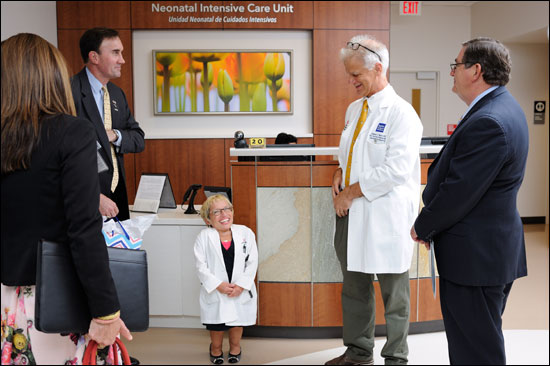
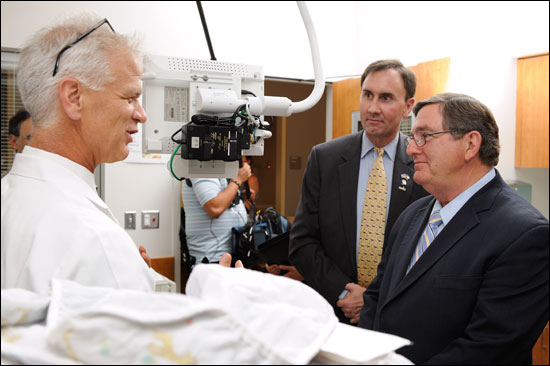
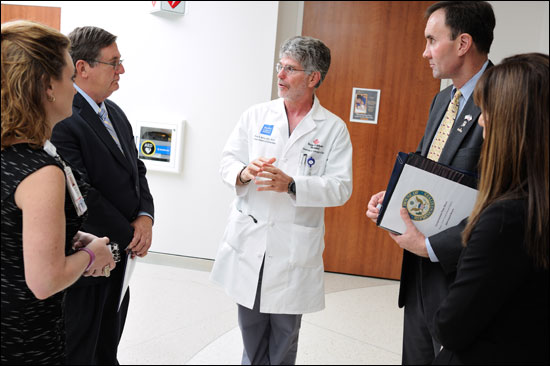
August Recess has historically been a time for members of Congress to spend time in their home states meeting with constituents. Taking advantage of this time at home, Congressmen Pete Olson and Michael Burgess made a trip to Texas Children’s to visit with leaders in the fields of pediatrics and obstetrics. The pair visited with Physician-in-Chief Dr. Mark W. Kline, Chief Financial Officer Ben Melson, OBGYN-in-Chief Dr. Michael Belfort, Chief of Neonatology Dr. Stephen Welty, and Director of Texas Children’s Simulation Center Dr. Jennifer Arnold among many others. They were accompanied by Director of Government Relations Rosie Valadez-McStay. The purpose of the visit was to bring awareness to how our hospital functions and what can be done legislatively to help organizations like ours continue to advance care for children and women.

“It’s incredibly important to have these legislators get a behind-the-scenes tour of how a hospital as large as ours operates and see first-hand how health policies and programs affect us and our patients,” said Valadez-McStay. “Specifically, we want our elected representatives to think of us as subject matter experts in Medicaid – to reach out to us when they are considering legislation or policy reforms – as any change in health policy could transform the lives of the sickest pediatric patients across the country and how children’s hospitals and health care professionals care for them.”

During the visit, the two were able to tour several areas in the Pavilion including the Maternal Fetal Medicine Clinic, the Women’s Intensive Care Unit and the Neonatal Intensive Care Unit. The NICU has some of the hospital’s youngest medically complex cases. These are the babies who could be affected by HR 4930, the Advancing Care for Exceptional Kids Act of 2014 (ACE Kids). The legislation, which was proposed last month, establishes pediatric centers of excellence through a federal designation. These Centers of Excellence would become the medical network for children with medical complexities on Medicaid. These hospitals would communicate and share information in order to allow for seamless care of these complex cases across state lines. For example, if a child in Louisiana with a medical complexity needs the care that is only available through specialists at Texas Children’s, once the legislation is passed, that child will be able to cross state lines to receive that care without wondering how their Medicaid will be affected. The hospital in Louisiana will also be able to better communicate with Texas Children’s to make sure none of the tests are unnecessarily duplicated and that when the patient returns home that care is coordinated and is tracked for health outcomes and quality.

Other August visitors included the staff of Senator John Cornyn, staff from the office of US Congressmen John Culberson and Ted Poe. Off-site visits by Texas Children’s government relations staff included meetings with Congressmen Gene Green and Kevin Brady.

Take action:
The ACE Kids Act has 34 cosponsors so far and is truly bi-partisan with 17 Republicans and 17 Democrats lending their support. Help us get more of our Congressional delegation to sign-on to the bill by joining in the Children’s Hospital Association’s social media Thunderclap – an echo of social media postings by all the children’s hospital members of CHA, urging our representative in the US House of Representatives to cosponsor the bill once they return from summer recess on September. 8. Sign up today at http://bit.ly/ACEKidsThunder with your Facebook, Twitter or Tumblr account to ensure that we reach our hospital goal and our message goes out as loudly as possible on September 8 at noon.

Click here to read more about the ACE Kids Act and how Dr. Jennifer Arnold used her voice to Speak Now for Kids. (internal link)

See the Photo Gallery:

82714dietrichbook640

Reaching puberty is a rite of passage that we’ve all been through, but these days children are entering puberty at younger ages – like 7, 8, or 9 years old – compared to previous generations. It’s a trend that has many health providers and parents scratching their heads.

Precocious puberty, or early puberty, is one of several topics that Dr. Jennifer Dietrich and her colleagues explore in their newly published book titled, “Female Puberty: A Comprehensive Guide for Clinicians.”

“Things have changed compared to 100 years ago,” said Dr. Jennifer Dietrich, chief of pediatric and adolescent gynecology at Texas Children’s. “Our nutrition today is different than it was back then. There are environmental factors, including childhood obesity, that potentially could impact the age at which children reach puberty. Our book explores all of these topics.”

The 159-page comprehensive manual is categorized into three main areas – normal, early and delayed puberty – and covers a spectrum of puberty-related topics and up-to-date clinical recommendations to help physicians better care for their patients, while making this journey through adolescence easier for moms and their daughters.

“Female Puberty: A Comprehensive Guide for Clinicians” examines case studies and current data trends on puberty, the potential impact of environmental factors and childhood body weight on the age of puberty, and whether the age of puberty is changing or is simply being measured and diagnosed differently.

Dietrich says it took years of rigorous research, intensive writing and multiple rounds of edits to bring this project to fruition. She and her colleagues – many of whom completed their fellowship in pediatric and adolescent gynecology at Baylor College of Medicine – were each assigned a chapter to write in six months before all the material was submitted to Springer for final approval.

“I am glad that Springer published our book,” said Dietrich. “I believe this will be an invaluable resource tool for all clinicians who specialize in female reproductive health including obstetrician gynecologists, reproductive endocrine specialists, pediatricians, family practitioners and allied health professionals.”

Dietrich’s book will be highlighted at upcoming conferences of The American Society for Reproductive Medicine, North American Society for Reproductive Medicine, North American Society for Pediatric and Adolescent Gynecology, and The American College of Obstetrics and Gynecology.

If you’re interested in purchasing the book online, click here for more information.