January 6, 2015

1715CarlaGiannoni175

Historically, it has been difficult to schedule surgery from Texas Children’s Hospital locations outside Main Campus. A pilot project launched a few months ago in the Division of Otolaryngology has overcome this challenge and made scheduling surgery from remote locations easier.

Surgeons now can insert an order into Epic at the time of a patient visit. Previously, when otolaryngologists traveled to see patients, they faxed or transported paper forms to Main Campus or called to schedule surgery.

“Those methods of scheduling surgery from offsite locations were less efficient and rife with opportunities for missed communications,” said Dr. Carla Giannoni, the Texas Children’s otolaryngologist who spearheaded the project.

Now, surgeons can use Epic to immediately submit an order for surgery.

“When I am at a satellite office, I am able to request the exact procedure I want, including special details, without depending on a faxed piece of paper to get to my scheduler at Main Campus,” Giannoni said. “The need to communicate about an upcoming surgery is resolved instead of having to be logged, tracked, and communicated back at a later date and time.”

In addition, the project provides for more secure patient information and increases HIPAA compliance.

“The potential to lose patient information has been eliminated with this new process,” she said. “The program has worked very well for me.”

Plans to roll out this program to other Department of Surgery divisions are underway. Surgical Services Director Trent Johnson said it will likely start early this year in the Division of Ophthalmology.

bump-watch

By Dr. Gail Demmler-Harrison

Congenital cytomegalovirus (CMV) is the most common virus that most people have never heard of. Most everyone will catch CMV at some time in their lives and never know they have it.

If a woman gets CMV for the first time while she is pregnant, she can be in a potentially dangerous situation. CMV infects almost 1 out of every 100 newborns in the United States and is the most common congenital infection.

The virus is passed to the unborn baby from the mother and can cause serious complications in the newborn, like platelet problems, liver disease and lung disease. It can also cause long-term effects on hearing, vision, growth and development by invading the brain, eyes and ears.

What makes CMV even more dangerous is that most people, including pregnant women, have never heard of CMV. Since CMV does not cause a rash like its cousin, chicken pox, you do not know who is infected and shedding the CMV.

The good news is CMV infection is potentially preventable.

If a pregnant woman is aware of CMV, she can take simple hygienic precautions to reduce her exposure to the virus. Toddlers are a “hot zone” for CMV, and by slightly modifying your behavior while pregnant, you can reduce your risk of catching this silent virus.

CMV is present in saliva and urine, so…

  1. Do not share food or drink with your toddler — no more “one for mommy one for baby” mealtime games while you’re pregnant.
  2. Do not kiss your toddler on the lips or cheek, rather hug them and give them a loving kiss on the top of the head while you’re pregnant.
  3. Wash your hands carefully after changing diapers and wiping your toddler’s nose and face.

An ounce of CMV awareness and three simple hygienic precautions while you’re pregnant are all it takes to save your unborn baby from a potentially devastating infection.

But, what if you contract CMV during pregnancy? I’ve put together a list of questions and answers with basic information that I hope you’ll find helpful. Click here to read my other blog.

1715AMTAfultzaward640-2

Amy Smith, a board certified music therapist at Texas Children’s, received the prestigious 2014 Arthur Flagler Fultz Research Grant from the American Music Therapy Association (AMTA).

The grant will support Smith’s study, “The Effects of Live Contingent Singing on Preterm Neonates with Bronchopulmonary Dysplasia,” which will examine the impact of a live music therapy intervention on the physiologic and behavioral responses of preterm infants with a chronic lung condition.

The study is slated to begin in early 2015 and run through mid-2016. The research team includes physicians, nurse practitioners and researchers from Texas Children’s Hospital. The results from the study will provide important information on the potential impact of music therapy on the overall well-being of infants with chronic and long term hospitalization needs.

The AMTA Arthur Flagler Fultz Research Award is the largest and most prestigious grant awarded to one individual each year from a highly competitive field of applications.

“I am honored to receive this research grant award,” said Smith. “This generous funding will help us advance music therapy research and identify innovative music therapy treatments for Texas Children’s patients.”

Since the hospital launched the program in 2013, Smith has provided music therapy to patients in the Neonatal Intensive Care Unit and the Inpatient Rehabilitation Unit.

The Music Therapy program is part of the Creative Arts Therapy program in the Child Life Department which provides developmental, educational and therapeutic interventions for children undergoing medical treatment.

“Music therapy is about providing families with the tools to interact and bond with their babies,” said Smith. “When a parent has a very small and very sick baby, they may be unable to hold or touch their newborn and music therapy can encourage bonding through songs and lullabies.”

Click here to watch a video about Texas Children’s Music Therapy program. For more information about music therapy, click here to visit our website.

1715parentsnight320

Texas Children’s Hospital Autism Center and Meyer Center for Developmental Pediatrics opened its doors December 19 for its inaugural Parents’ Night Out event. Fourteen children participated in the event, which was open to clinic patients as well as their siblings. The event was staffed by volunteers from the Autism Center and Meyer Center, including physicians, psychologists, social workers, medical assistants, and administrative staff.

The idea to host a Parents’ Night Out came from a team discussion about how to give back to the patients and their families during the holiday season. Offering such an event allowed the clinic to reach several families and to give parents a much-valued gift: time. For many parents, finding reliable and trustworthy child care is difficult. For parents of children with developmental disabilities such as autism or intellectual disability, finding such child care is nearly impossible. This event provided parents with the peace of mind that their child was in a safe environment and was being cared for by trained professionals in a familiar place, which allowed the parents to then truly relax and enjoy a few hours to themselves. Many parents shared that it was the first time in months that they were able to spend the evening relaxing, going out to dinner, shopping, and going to the movies.

The children were welcomed by enthusiastic volunteers, and there were various activities and games set up for their enjoyment. Kids decorated holiday cards and cookies, played Nintendo Wii, board games and musical instruments, and kept busy playing soccer and catch. The children interacted really well together, and it is safe to say that everybody made some new friends that evening. Many parents told staff the following week that their kids kept asking when they were going to see their “new friends” again, and when they get to go “back to their doctor’s office to play.”

All in all, it was a successful evening. The children had a great time, the parents were extremely appreciative of the time volunteered by the staff, and the volunteers enjoyed spending time with the kids outside of the clinic setting. It was a wonderful way for the Autism Center and Meyer Center to kick off the holiday season!

December 23, 2014

122414sightsandsounds640

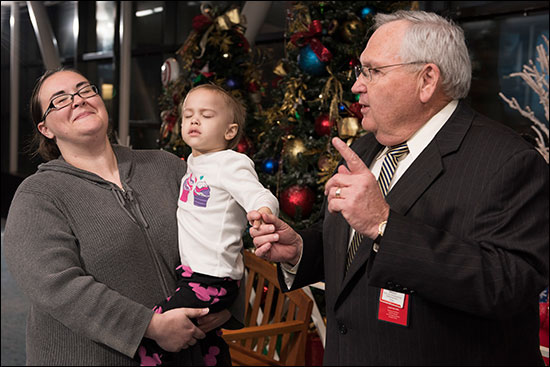
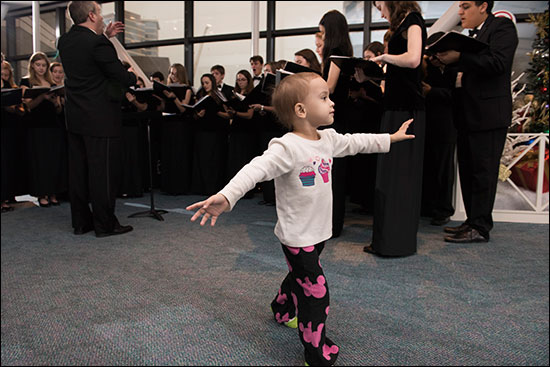
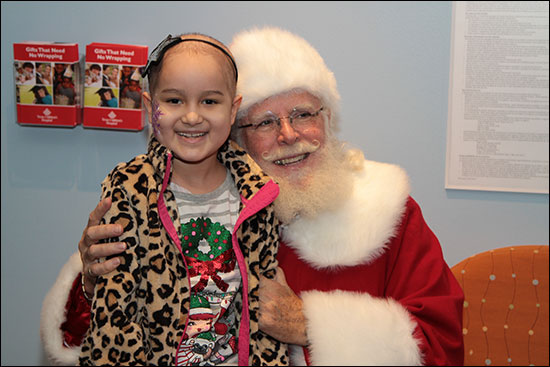
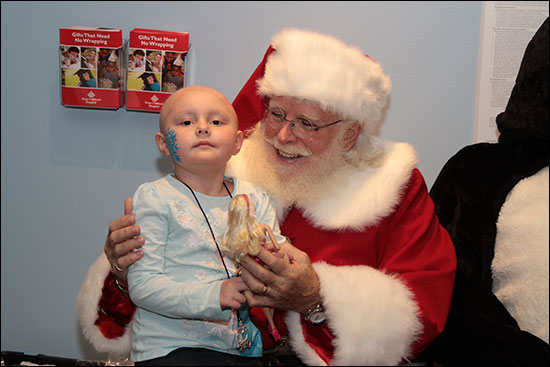
Little Penelope danced to the sounds of the St. John’s School Choir singing Christmas carols on The Auxiliary Bridge as her mom watched waiting for Santa’s arrival. Penelope is a patient in Texas Children’s Cancer Center and spent her day receiving chemotherapy, but at that moment, her mom was filled with joy as she watched her little girl enjoying a little holiday cheer.

Executive Vice President and Chief Operating Officer Randy Wright took Penelope by the hand and asked her to close her little eyes and make a holiday wish. As she did this, the sparkling lights on the Christmas décor turned on and in walked who else, but Santa and Mrs. Clause. “Ho ho ho” Santa said as Penelope and the other little children erupted in cheer. Penelope ran right up to Santa and gave him a great big hug. She was first in line to tell him her holiday wish list followed by dozens of other patients excited to meet the hero of the holidays.

That was just the beginning of the holiday cheer. Throughout the season, the patients received special visits from Santa and his little helpers. There was the visit from the Houston Ballet Nutcracker performers, the Ukulele club’s caroling through the halls and a virtual visit from the North Pole as patients skyped with Jolly St. Nick.

Watch the short video above and browse the photo gallery to see some highlights of the holiday cheer.

122414matatwins640

Conjoined 8-month-old twin girls, Knatalye Hope and Adeline Faith Mata, underwent a five-hour surgery December 16 at Texas Children’s Hospital Main Campus to place custom-made tissue expanders into their chest and abdomen area. The tissue expanders will help stretch the babies’ skin in preparation for their separation surgery, which is expected to take place early next year.

During their recent surgery, the infants also had an examination to help assess their anatomy and the placement of PICC catheters in preparation for the twins’ separation. Dr. Alberto Hernandez with Interventional Radiology performed the examination. Chief of Plastic Surgery Dr. Larry Hollier and Dr. Ed Buchanan with the Division of Plastic and Reconstructive Surgery conducted the tissue expander placement surgery. Dr. Helana Karlberg led the anesthesia team and Audra Rushing led the surgical nursing team.

“We are pleased the babies did so well during the surgery,” Hollier said. “A multidisciplinary team continues to monitor them in our neonatal intensive care unit as they recover.”

The tissue expander placement surgery requires a recovery time of six to eight weeks, during which additional fluid will be added to the tissue expanders, which are like balloons, to allow the skin to be stretched gradually. The extra skin is needed to provide coverage once the babies are separated.

During the girl’s recovery, the planning process for the separation surgery will continue among a team of multidisciplinary specialists in pediatric surgery, urology, plastic surgery, orthopedic surgery, cardiovascular surgery and pediatric gynecology.

“We have been preparing for the twins’ separation surgery for months and the process is ongoing,” said Dr. Darrell Cass, pediatric surgeon and co-director of Texas Children’s Fetal Center. “In addition to multidisciplinary meetings, our plans have included, among other things, building a 3-D model of their organs, conducting simulations of the surgery and post-operative care they will receive, as well as helping create devices to support their care, such as a swing which will hold the girls upright to alleviate pressure on their healing incisions.”

Anticipated to take approximately 24 hours, the separation surgery will involve two teams of surgeons who will work together to separate the twins, who share a chest wall, lungs, pericardial sac (the lining of the heart), diaphragm, liver and pelvis. The separation team will start the surgery and the reconstruction team will complete the procedure.

Surgeons at Texas Children’s Hospital in 1992 successfully separated Tiesha and Lesha Turner, who were 1 year old and shared a sternum, liver, entwined intestines and fused organs. The separation of Knatalye and Adeline will be the second such procedure performed at the hospital.

Cass said he expects the surgery to go well and for each child to be able to live independently and to have a good life.

Knatalye and Adeline were born April 11 at Texas Children’s Pavilion for Women. Delivered via Caesarean-section at 31 weeks gestation, the twins each weighed 3 pounds, 7 ounces.

The girls’ parents, Elysse and John Mata, and their 5-year-old brother, Azariah, learned during a routine ultrasound on Jan. 13 that Elysse was carrying twins and they were conjoined. Subsequently, the family was referred from a physician in Lubbock, their hometown, to the Texas Children’s Fetal Center where they underwent extensive prenatal imaging, multidisciplinary consultation and development of plans to achieve a safe delivery and postnatal care.

Now 8 months old, the babies weigh about 15 pounds each and are doing well as they continue to be cared for by a team of specialists in the Level IV neonatal intensive care unit at Texas Children’s Hospital.

Elysse Mata said the day before the tissue expander placement surgery she is confident her girls are in good hands at Texas Children’s Hospital.

“I have an extreme amount of faith in the team at Texas Children’s and in God,” she said. “I know He put us here for a reason.”

122414patientsafety640

The Solutions for Patient Safety (SPS) network has named Texas Children’s Hospital of the Month for the month of December in recognition of the organization’s efforts to improve patient safety and decrease patient harm. The award recognizes the hospital for many steps taken toward increasing patient safety including the organization of 10 different hospital acquired conditions (HAC) teams which include more than 100 employees and clinical staff. These teams review best practices from other hospitals within the network and implement those that work, while also sharing our successes with others. The award also recognizes the teams which have seen significant improvements since taking on new protocols. Over the last year, five teams have demonstrated significant decreases in harm by implementing process recommendations from the SPS network. The falls, surgical site infections, central line associated bloodstream infection and urinary tract infection HAC teams have fully adopted SPS prescribed bundles.

“As an organization, we are proud to be a part of a nationwide effort to decrease harm to patients,” said Trudy Leidich, director of quality and safety. “Through the Solutions for Patient Safety initiative, we have been able to share our best practices with other children’s hospitals and learn from their efforts as well. Being named hospital of the month is simply an acknowledgment that we are doing everything we can to improve safety within our hospital and we are honored to get this recognition.”

The SPS, formerly known as the Ohio Collaborative, began as a group of Ohio children’s hospitals working toward eliminating patient harm and soon expanded to a network of more than 80 hospitals across the nation, including Texas Children’s, which lead a national effort to implement the best strategies for creating the highest possible safety protocols for patient care.

Data sharing in the form of outcomes and process measures is another key component of the hospital’s participation in the collaborative. This data is combined with data from other participating hospitals to help identify trends and refine practice which result in an improvement of care. Since January 2013, Texas Children’s Hospital has submitted 100 percent of its HAC and Readmissions outcome data to the SPS.

Teams from Texas Children’s will continue this ongoing partnership with SPS and children’s hospitals across the nation to improve the quality and safety of care to our patients.