July 28, 2015

72915ROTB640Have you ever wondered what it feels like to run on the floor of NRG Stadium, home of the Houston Texans? If so, you and your child now have a chance. All you have to do is sign up for the TORO’S Kids 1K on Sunday, September 20.

Presented by Texas Children’s Hospital, the stroller-friendly run/walk is for children 12 years old and younger. All race participants must be accompanied by a parent or guardian and will cross the finish line on the floor of NRG Stadium – all TORO’s Kids 1K participants also will receive medals.

The 1K event will be followed by the fifth annual Running of the Bulls 5K run/walk presented by H-E-B at NRG Stadium. The post-race party for both races will be held on the floor of NRG Stadium and will include opportunities to receive autographs from Houston Texans Cheerleaders, Ambassadors and TORO. In addition, race participants can enjoy free food and drinks, giveaways and live music.

For more information about the event or to sign up, click here.

72915surgery360The Texas Children’s Hospital Auxiliary awarded urologist Dr. Patricio Gargollo the Denton A. Cooley Fellowship in Surgical Innovation Award and orthopedic surgeon Dr. Scott Rosenfeld the Outcomes Fellowship Award for 2015. Each award totals $75,000. This is the fourth year the Department of Surgery has received funding from the Texas Children’s Auxiliary.

The Denton A. Cooley Fellowship in Surgical Innovation Award is given to a physician whose surgical research focuses on innovative ways to help children and to save lives. The Outcomes Fellowship Award supports patient care, education and research.

Gargollo is director of the Program for Complex Urogenital Reconstruction, associate medical director for Pediatric Surgery of the Texas Children’s Simulation Center and co-director of the Urology Robotic and Minimally Invasive Surgery Program. With his award money, Gargollo proposes to integrate clinical simulation into the curriculum for medical students, residents, fellows and physician assistant fellows. Specifically, he proposes to combine training in laparoscopic techniques and simulation technology.

Rosenfeld specializes in pediatric orthopedics, sports medicine, scoliosis and hip disorders. He also is co-director of the Adolescent and Young Adult Hip Clinic at Texas Children’s. With his award money, Rosenfeld proposes to develop diagnostic algorithms for pediatric musculoskeletal infections and determine the most efficacious means of treatment. These clinical practice guidelines will be region specific, making them useful in all parts of North America.

July 21, 2015

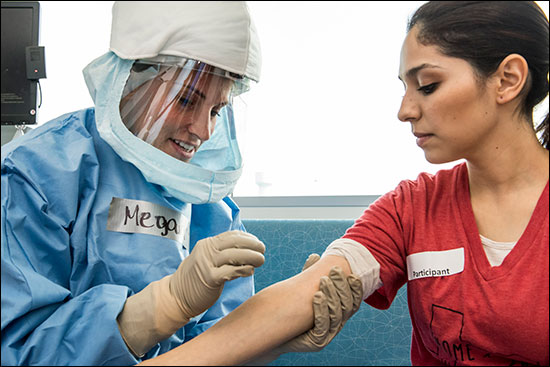
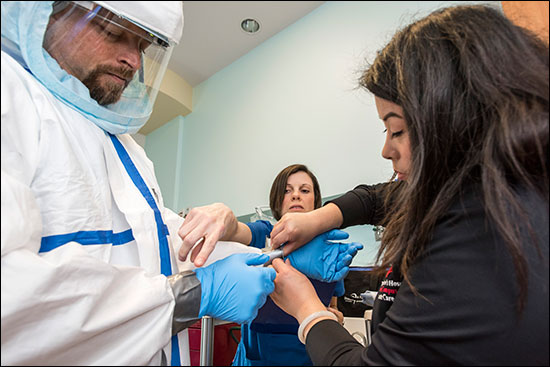
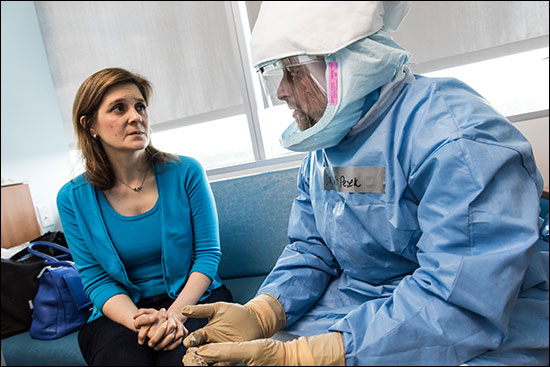
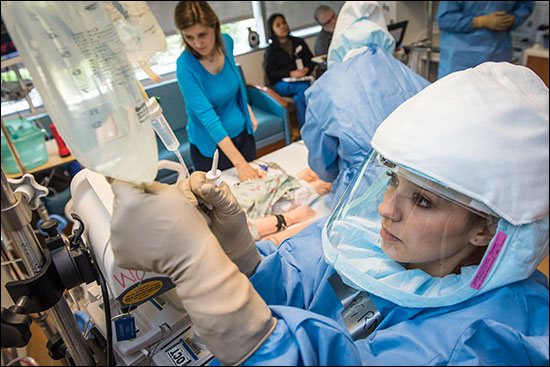
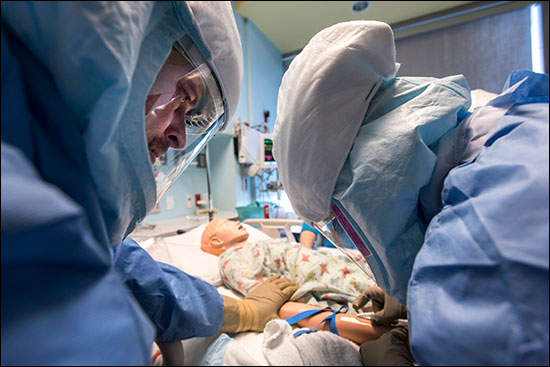
72215WCSIU640Two nurses and a doctor donned personal protective equipment before entering the hospital room to check on the young patient who was exhibiting signs of a highly infectious disease.

While the physician patiently talked with the child’s worried mother, the nurses checked the patient’s vitals and drew a blood sample to be tested for diseases such as Ebola, Lassa and Marburg fevers.

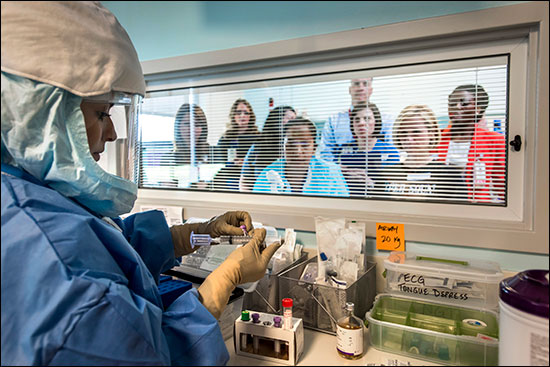
A lab technician dressed in personal protective equipment gathered the blood sample and took it to a nearby lab that would produce results within hours.

Meanwhile, the doctor and nurses worked with a team of medical professionals watching and advising from an adjacent room equipped with an observation window to keep the patient stabilized.

Fortunately, this was not a real scene at Texas Children’s Hospital West Campus but a detailed simulation that recently occurred in the soon-to-be-finished special isolation unit.

In October, the state-of-the-art facility will open its doors and a Special Response Team will stand ready to receive children suspected of having a highly contagious disease.

“Having a special isolation unit at Texas Children’s Hospital West Campus will allow our system to offer our exemplary medical care to a very vulnerable population,” said West Campus President Chanda Cashen Chacón. “We have made tremendous progress since announcing the project in December and are still working full speed ahead.”

Construction on the eight-bed unit is near completion with operational planning, team training and final construction progressing rapidly. The project is like no other at Texas Children’s since the special isolation unit will incorporate all of the latest scientific and technological approaches to biocontainment, including negative air pressure, laminar air flow, high-efficiency particulate air (HEPA) filtration, separate ventilation, anterooms, biosafety cabinets, a specialized laboratory, special security access and autoclaves.

When complete, the unit will be fully equipped to care for any infant or child with a serious communicable disease, with all of the measures available to assure safety of the health care team, other patients and their families. The specialized biosafety level 3 laboratory will enable the care team to monitor the progress of patients and perform rapid detection methods to identify unusual pathogens.

Dr. Gordon Schutze will serve as medical director of the special isolation unit and Drs. Judith Campbell and Amy Arrington will be the unit’s associate medical directors. An elite volunteer-based team of experienced nurses and physicians – all of whom will have successfully completed an intensive advanced certification course and practicum in infection control, hospital epidemiology and management of infectious diseases in the critical care setting – will staff the unit.

Many members of the Special Response Team have been chosen, however recruitment for physicians, nurses, laboratory technicians and environmental services personnel is ongoing. To learn more about joining the Special Response Team, click here.

“The team that staffs this unit is key to making it successful,” Campbell said. “Many of our talented staff have stepped up to the plate to participate in this noble endeavor and we need more to raise their hands to volunteer.”

Another aspect of the unit that has recently ramped up is training and education. Led by Arrington, the training and education program for the special isolation unit is robust and has already included two almost full-day simulations. The first of which was a mid-construction simulation to assess any environmental issues important to the performance, health, comfort and safety of both our patients and our medical staff. The second simulation focused on clinical scenarios involving a patient suspected of having a highly contagious disease.

“The more we train the better off we will be in the event of an infected patient,” Arrington said. “It’s an ongoing process.”

When Cade Beasly’s parents got the news that their little boy was diagnosed with Osteo Sarcoma, it was a devastating moment that brought many fears. For nearly nine months, Cade underwent treatments that left him weak and tired. On May 27, Cade’s tests came back and he was finally declared cancer-free. He would no longer be spending hours at a time on the 14th floor of the Clinical Care Center as he endured pricks while receiving life-saving medications. Just a few weeks later, Cade was back for a special occasion. He was one of the first children to ring the end of treatment bell.

“It makes me so happy to see him ring that bell signaling the end of his treatment,” said Cade’s mom Jessica Peterson. “There are so many emotions when you reach the end of your child’s treatment, but this moment is definitely a happy one.”

Cade was there to join his friend Ethan Williamson who donated the bells, one on the inpatient cancer and hematology unit and one for the outpatient unit. Each Bell is placed next to a plaque that reads, “Let your strength and courage be felt by all, as this bell’s song fills this hall. For every time we hear this note, another life be filled with hope. Stay strong.”

The bells were unveiled during a ceremony within each unit that brought out patients, families and the cancer and hematology centers staff.

Purple Songs Can Fly artist and cancer survivor Christian Spear dedicated a song for the ceremony. Listen to the touching lyrics below.

72215ICD10640In less than 72 days, the codes that health care organizations use to report medical diagnoses and inpatient procedures will become standard across the globe. The federally-mandated conversion from ICD-9 to the expanded ICD-10 coding system will be implemented on October 1. This universal system will help us gather more accurate data, make more informed decisions and ultimately help us achieve better outcomes for our patients.

Texas Children’s ICD-10 preparedness teams have been working diligently for more than a year to ensure we are ready systemwide for this transition. We need you to be prepared as well. If you are a provider or a coder or work in any of the other impacted roles, make sure you complete the required training and education needed to ensure readiness.

Our goal is to reach 100 percent compliance by September 1, which is less than six weeks away.

Based on the latest education compliance statistics, we have a lot of work ahead of us to successfully achieve this organization-wide endeavor. Currently, 11 percent of Texas Children’s providers and 7 percent of nonclinical employees have completed their mandatory educational requirements. By educating ourselves over the next few weeks, the result will be a smooth transition come October 1.

Texas Children’s has partnered with Baylor College of Medicine to provide e-learning videos for our medical staff. Each clinical service area and identified departments have been assigned a self-paced learning module. The ICD-10 education team has prepared an area-specific curriculum for nonclinical employees that is available online through Health Stream.

To access the ICD-10 physician learning modules:
Go to www.healthstream.com/hlc/bcom.

Step 1: Enter your user name and password to log in:

  • Baylor providers – enter your current Baylor user ID and your employee identification number (typically a 5 or 6-digit number. If you need to reset your password, contact the Baylor Help Desk at 713-798-8737.
  • Texas Children’s and Texas Children’s Pediatrics providers – enter your NT login (Epic login). Then, enter this password: icd10. You will be prompted to reset your password.

Step 2: Access your specialty’s courses:

  • Select the My Learning tab at the top left of the screen
  • View the list of courses required for your specialty
    • Note: The assessment at the end of the course must be completed in order for the course to be marked as complete.
  • Optional: If you are interested in accessing other courses:
  • Click on the Catalog tab
  • Type in the specialty of interest to enroll in an additional course

All of the courses have been reviewed and approved by the appropriate section lead.
Note: CME credits are available for the general courses. These courses require a pre- and post-quiz to fulfill CME credits, and only on their completion will the courses be marked “complete.”

If you have questions with the Precyse learning modules, email Marcy Medlak at mamedlak@texaschildrens.org

To access the ICD-10 nonclinical learning modules:

To view, log into Health Stream (http://decisioncritical.ad.texaschildrenshospital.org/)

Step 1: Choose student/manager role. The courses are directly assigned to you.

Step 2: Click “Enroll in this course” to view.

Below are links to a quick fact sheet and helpful sites with basic information on ICD-10 to see how this change will impact your own medical record documentation:

ICD-10 Video
ICD-10 Fact Sheet
ICD-10 Industry Updates
ICD-10 Myths and Facts

72215nursingeducation640Nurses from all over the organization are invited to join an around-the-clock nursing professional day designed to educate through knowledge sharing. The 24-hour event is a first-of-its-kind seminar-style program that allows nurses with expertise in specific areas to present, sharing their knowledge with their colleagues. The nursing professional day is aimed at improving patient care and promoting professional development and nursing excellence. It fosters collaboration and teamwork within the vast department of more than 2,700 nursing professionals.

The day was organized based on identified learning needs gathered from a survey sent out to nurses across the organization.

“The concept came about in order to educate and develop all nurses via ‘knowledge sharing’ on a global scale in a meaningful and impactful way,” said Leslie Morris, one of the event’s organizers. “The purpose of this day is to promote professional development of registered nurses throughout the organization.”

The sessions provide increased knowledge and clinical skills. Participants will receive up to six hours of CNE credit with no fees.

Various topics are approached by different nurses presenting to their colleagues from across the organization.

The sessions include:

  • Building Relationships
  • Workplace Civility
  • Team Collaboration
  • Crucial Conversations
  • Escalating Concerns
  • Delegation
  • Managing Conflicts
  • Team Building
  • Communication with patients and families
  • Specialty Certification
  • Nursing Portfolio
  • Risk Management
  • Legal Issues
  • Ethics in Care
  • Evidence Base Practice
  • Disease Management
  • Treatment Decisions
  • Quality Improvement
  • Documentation Practice
  • Standard of Care
  • Code Management
  • Patient and Family Education
  • Trauma

The day will be a come-and-go format and does not require registration. The 24 hour period is designed to encourage all nurses to join for as long or as little as they can throughout their workday or before and after work. The session is coordinated in the 24-hour format to allow both day and night nurses to take advantage.

Nursing professional day will be held from 8 a.m. Wednesday, July 29, to 8 a.m. Thursday, July 30, on the fourth floor of the Pavilion for Women.

Texas Children’s Hospital is an approved provider of continuing nursing education by the Texas Nurses Association, an accredited approver by the American Nurses Credentialing Center’s Commission on Accreditation.

72215HHconference640On July 11, Texas Children’s Hospital and Hope for Hypothalamic Hamartomas hosted an educational conference to empower patients and their families affected by a rare and often devastating brain condition.

Hypothalamic Hamartoma (HH) is a noncancerous tumor of the hypothalamus that causes uncontrollable seizures, early puberty, hormonal imbalances and cognitive and behavioral problems. Seizures usually begin in infancy, most often as frequent, uncontrollable laughing spells (gelastic seizure), before different types of seizures emerge.

Texas Children’s neuroscience team along with Dr. Daniel Curry, Texas Children’s director of pediatric surgical epilepsy and functional neurosurgery, and Dr. Angus Wilfong, medical director of Texas Children’s Comprehensive Epilepsy Program, helped organize the HH Family Conference which featured insightful presentations from 11 experts from across the country who specialize in the diagnosis and treatment of neurological diseases.

The conference provided valuable information about exciting research on the horizon and potential new treatments for HH patients, with the hopes of empowering families and caregivers to make educated treatment decisions for their loved ones.

Several guest speakers from Texas Children’s included Drs. Wilfong, Maria Grosch, Marcia Komlos-Kukreja, Michael Quach, Varina Wolf, and Curry, who delivered a presentation on laser ablation technology, a surgical procedure he and Wilfong helped pioneer to treat seizures in children with epilepsy and HH.

Ranked no. 2 in neurology and neurosurgery by U.S. News & World Report, Texas Children’s is the first hospital in the world to use this real-time MRI-guided thermal imaging and laser technology to destroy brain lesions that cause epilepsy and uncontrollable seizures. Unlike a craniotomy – which removes a larger area of skull bone – the MRI-guided laser probe uses a much smaller pathway through the brain to reach a lesion. This minimally invasive surgery has resulted in promising outcomes for HH patients, with 78 percent of them being able to live seizure-free.

“Several of our families have been treated by this new laser ablation surgical procedure that Drs. Curry and Wilfong have worked hard to perfect on our high-risk patients,” said Lisa Soeby, president of Hope for Hypothalamic Hamartomas. “We are thankful for their dedication and passion for what they do and look forward to partnering with Texas Children’s Hospital in the future.”

In addition to providing informative sessions, the HH Family Conference also offered opportunities for families to meet others like them, who are impacted by this rare but treatable condition.