March 1, 2016

3216pearlanduc640Texas Children’s Hospital is proud to announce the opening of its fifth Texas Children’s Urgent Care clinic. Conveniently located at 2701 Pearland Parkway, the clinic offers high-quality, efficient and affordable pediatric care at a convenient Pearland location.

“We are very excited to open our fifth location and bring expert pediatric urgent care to the Pearland community,” said Kay Tittle, president of Texas Children’s Pediatrics. “Our Urgent Cares clinics provide an immense resource for the communities we serve and I am looking forward to seeing the impact this location will have on the children and families of Pearland.”

Texas Children’s Urgent Care Pearland is open Monday through Friday, 4:30 p.m. to 11 p.m. and Saturday and Sunday, noon to 8 p.m. The clinic is staffed by board certified pediatricians who have privileges at Texas Children’s Hospital. Pediatricians diagnose and treat a wide variety of ailments, illnesses and conditions, including: asthma, strep throat, fever, minor burns, influenza, ear infections, allergic reactions and more. Procedures provided include: antibiotic injections, breathing treatments, fracture care and splinting, IV (intravenous) fluids, lab services, laceration repair and X-rays onsite.

Oftentimes, families turn to an emergency center after hours, on weekends or perhaps even during the day, when a significant event occurs with their child. Though the emergency center is the right place for some incidents or ailments, the majority of the time minor illnesses can and should be treated at a pediatric urgent care facility.

Texas Children’s Urgent Care accepts major insurance plans and has self-pay rates, which are less than emergency center charges, and there are no hospital fees. A complete list of insurance plans is available on the website. Texas Children’s Urgent Care specializes in after-hours care, but does not replace the need for children to have a general pediatrician. Routine physical exams and vaccinations are services that should be obtained from a general pediatrician, and these services are not available at Texas Children’s Urgent Care.

Texas Children’s Urgent Care has four additional convenient locations:

  • Cinco Ranch located at 9727 Spring Green Blvd., Suite 900 Katy, TX 77494
  • Memorial located at 12850 Memorial Drive, Suite 210 Houston, TX 77024
  • The Woodlands located at 4775 W. Panther Creek Drive, Suite C300 The Woodlands, TX 77381
  • Main Campus located at 6621 Fannin, Suite 2240 Houston, TX 77030

bench-and-beside-Header2 Bench and Bedside is a digest of the previous month’s stories about the clinical and academic activities of our physicians and scientists. We welcome your submissions and feedback.

February 2

Texas Children’s, Rice University team up to develop new way to repair birth defect

Bioengineers at Texas Children’s Hospital and Rice University have won a National Institutes of Health grant to develop a new generation of patches to repair the damaged hearts of infants. The $1.9 million, 5-year grant will allow Jeffrey Jacot and his team to take the next steps in a long-running drive to improve the survival rates of such infants, many of whom are diagnosed in utero and require surgery soon after birth.

February 2

Department of State Health Services to award Texas Children’s $1 million grant for SIU 3116SIUTraining300

Texas Children’s is set to receive a $1 million grant from the Texas Department of State Health Services (DSHS) to put toward its newly constructed Special Isolation Unit at Texas Children’s Hospital West Campus. The funds, to be delivered during the next five years, will specifically go toward Ebola preparedness activities that bolster employee safety and quality of care.

February 2

Texas Children’s convenes task force, urges employees to educate themselves on Zika

3116zikamosquito300In light of the multiple confirmed cases of Zika infection in Texas due to foreign travel, Texas Children’s leaders encourage employees, particularly pregnant women, to refrain from traveling to areas where the outbreak is growing and to follow precautionary measures to protect themselves from Zika exposure. Since the mosquito-carrying virus has been known to increase the risk of microcephaly, a neurological fetal birth defect, Texas Children’s recently convened a task force to develop management and research strategies based on screening criteria outlined by the Centers for Disease Control for pregnant women who may have been exposed to the Zika virus.

February 2 Kline: Children deserve access to best care

Many patients have been left scrambling to find a new medical home when a number of insurance companies decided not to provide in-network coverage for many hospitals in the Texas Medical Center, including Texas Children’s Hospital. Physician-in-Chief Dr. Mark W. Kline talks about how all children deserve access to the best care.

February 2

Zoghbi to receive medal for pioneering advancements in neuroscience research

3116zoghbilab300Dr. Huda Zoghbi, director of the Jan and Dan Duncan Neurological Research Institute at Texas Children’s, will receive the 2016 Jessie Stevenson Kovalenko Medal from the National Academy of Science in April for her achievements in neuroscience, which includes unlocking the genetic and molecular mysteries behind rare neurological disorders.


February 2

Clinical Research Center presents research award to Dr. Anvari

The Clinical Research Center will present the Clinical Research Award for First Quarter 2016 to Dr. Sara Anvari, physician, Allergy and Immunology. Dr. Anvari is a dedicated clinical scientist for the food allergy research trials at Texas Children’s Hospital.

February 9

Three NRI researchers recognized for their contributions to neuroscience research

Drs. Michael Wangler and Shinya Yamamoto recently obtained a research grant from the Simon’s Foundation for Autism Research Initiative (SFARI) to advance their study on autism spectrum disorders. Their study titled, “In vivo functional analysis of autism candidate genes” is one of five projects selected for research funding by the SFARI. Dr. Andrea Ballabio, founder and director of the Telethon Institute of Genetics and Medicine (TIGEM), Italy, professor at Baylor and faculty member at the NRI, has been selected to receive the 2016 Louis-Jeantet Prize for Medicine. He will share this award with biochemist John Diffley, associate research director at the Francis Crick Institute, United Kingdom.

February 16

Study finds premature infants benefit from exclusive human milk-based diet

3116NEC300A recent Baylor College of Medicine study led by Texas Children’s neonatologist Dr. Amy Hair, and published in the journal Breastfeeding Medicine, found that premature infants weighing less than 1,250 grams at birth showed improved outcomes after being fed a human milk-based diet.


February 16

Mata twins celebrate one-year anniversary after historic separation 3116MataFamily300

A year after being separated in a marathon surgery at Texas Children’s Hospital, formerly conjoined twins Knatalye and Adeline Mata are healthy, lively toddlers. Several members of our medical staff involved in the girls’ care got to see how much they have grown and how far they have come during a recent visit to Texas Children’s for their follow-up appointments with pediatric subspecialists monitoring their health and development. Hear some of their reactions and see for yourself how much the girls have progressed.

February 16

Heart Center launches series of educational animated videos 3116animation300

Featuring an armadillo, a bison and robot-like caregivers called Blings, a series of animated videos created by Texas Children’s Heart Center aims to help educate patients and their families about various heart conditions and treatment options. Six of the videos were unveiled at a February 15 red carpet premier and can be accessed on the Texas Children’s website at http://www.texaschildrens.org/hearteducation.

February 23

CVICU physician performs CPR, saves man’s life during spin class

When Dr. Natasha Afonso clipped in to a bike for a spin class on a recent Thursday evening, she didn’t know the skills she uses each day to treat patients in the CVICU would mean the difference between life and death for a fellow rider. Toward the end of the 45-minute, high-intensity class, Afonso heard 50-year-old Scott Corron collapse and fall off his bicycle. Because he wasn’t breathing and had no pulse, Afonso immediately started CPR, an action that ultimately saved Corron’s life.

February 23

New in situ simulation program enhances role clarity in high-risk emergencies 3116sitasim300

Texas Children’s Simulation Center recently launched the first-ever Neonatal Comprehensive In Situ Simulation Program for NICU providers at the Pavilion for Women. The program focuses on improving crisis resource management skills, one of which is role clarity, to ensure all code team members know each other’s specific roles when delivering care to patients during high-risk medical emergencies.

February 23

Texas Children’s helps develop nation’s first hospital-based rapid test for the Zika virus

3116zikalab300Pathologists and clinical laboratory scientists at Texas Children’s Hospital and Houston Methodist Hospital developed the nation’s first hospital-based rapid test for the Zika virus in a matter of weeks as part of the L.E. and Virginia Simmons Collaborative in Virus Detection and Surveillance. Pathologist-in-Chief Dr. James Versalovic and Dr. James Dunn, director of medical microbiology and virology, led Texas Children’s Zika test development team. The new diagnostic test identifies virus-specific RNA sequences to detect the virus and can distinguish Zika virus from other virus infections like Dengue, West Nile or Chikunguny.

February 23

Blaney receives Pioneer Award for contributions in pediatric neuro-oncology The Children’s Brain Tumor Foundation honored Dr. Susan Blaney with the Pioneer Award for Pediatric Neuro-Oncology, celebrating her 25 years of dedication to the search for new and better treatments for children with brain and spinal cord tumors. Blaney’s extensive experience in clinical translational research focuses on developing new treatment strategies for children with brain tumors and other refractory cancers. Blaney has been instrumental in developing more new agent clinical trials than anyone in the field of pediatric oncology.

February 23

Dietrich voted president-elect of North American Society for Pediatric and Adolescent Gynecology

Chief of Pediatric and Adolescent Gynecology Dr. Jennifer Dietrich has been voted president-elect of the North American Society for Pediatric and Adolescent Gynecology. Her tenure as president-elect begins in April. She will be voted in as president in April 2017.

February 23

Texas Children’s Health Plan Center for Children and Women earns accolades for CenteringPregnancy® program Texas Children’s Health Plan’s Center for Children and Women has earned site approval for its CenteringPregnancy® program. The Centering Healthcare Institute (CHI) has awarded both the Southwest and Greenspoint locations the official designation for closely following the CenteringPregnancy® model.

February 23, 2016

22416zikatesting640Pathologists and clinical laboratory scientists at Texas Children’s and Houston Methodist Hospital developed the nation’s first hospital-based rapid test for the Zika virus in a matter of weeks as part of the L.E. and Virginia Simmons Collaborative in Virus Detection and Surveillance.

This collaborative program was established to facilitate rapid development of tests for virus detection in a large metropolitan area. These tests are customized to each hospital’s diagnostic laboratory and designed to provide results within several hours. Before the Zika test was developed, physicians faced the possibility of long delays of testing in local and state public health laboratories and the Centers for Disease Control (CDC).

Texas Children’s Pathologist-in-Chief Dr. James Versalovic and Dr. James Dunn, director of medical microbiology and virology, led Texas Children’s team tasked with developing a rapid test for Zika virus.

Transmitted primarily through mosquito bites, Zika is a flavivirus that contains RNA as its genetic material. This new diagnostic test identifies virus-specific RNA sequences to detect Zika virus and can distinguish Zika virus from other virus infections like Dengue, West Nile or Chikungunya. Every viral particle contains genes in its RNA and these RNA sequences are directly detected on blood, amniotic fluid, urine and spinal fluid.

Currently, only registered patients at Texas Children’s or Houston Methodist hospitals can receive the test but the labs will consider referral testing from other hospitals and clinics in the future.

The test will be initially offered to patients with a positive travel history and symptoms consistent with acute Zika virus infection such as a rash, arthralgias or fever, or asymptomatic pregnant women with a positive travel history to any of the affected countries. The World Health Organization has advised pregnant women to consult their doctors before traveling to places with Zika virus outbreaks and consider delaying travel. The CDC issued similar guidelines to pregnant women last month.

“With travel-related cases of the Zika virus becoming more prevalent in the U.S. coupled with the looming increase in mosquito exposure during spring and summer months, we must be prepared for a surge of Zika testing demand,” Versalovic said. “We must provide answers for anxious mothers-to-be and families who may experience signs and symptoms or may simply have a travel history to these endemic areas.”

Click here for more information about the Zika virus and what Texas Children’s maternal fetal task force is doing to develop strategies based on CDC screening guidelines for pregnant women who may have been exposed to the Zika virus.

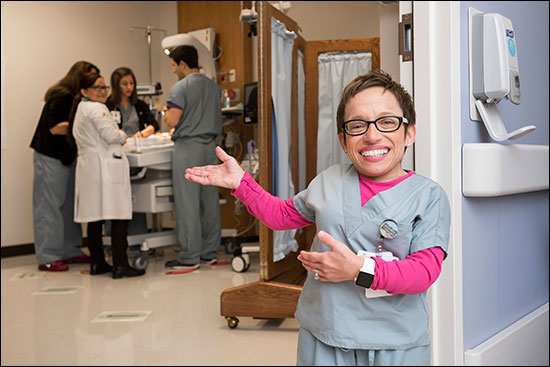
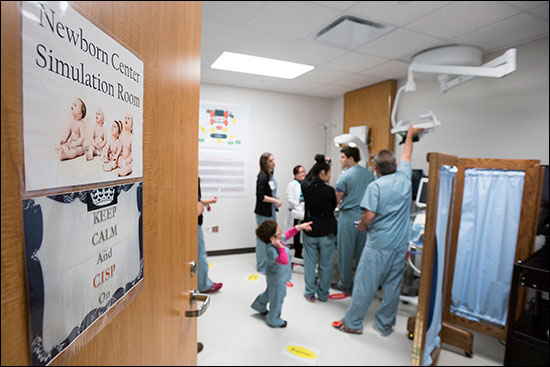
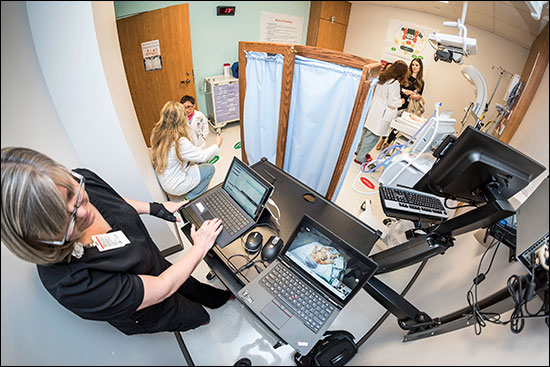
22416simulationinside640The neonatal team at Texas Children’s Pavilion for Women is always prepared for special deliveries – taking care of newborns is what they’re trained to do. But earlier this month, the neonatal intensive care unit (NICU) received a special delivery that wasn’t quite what you’d expect.

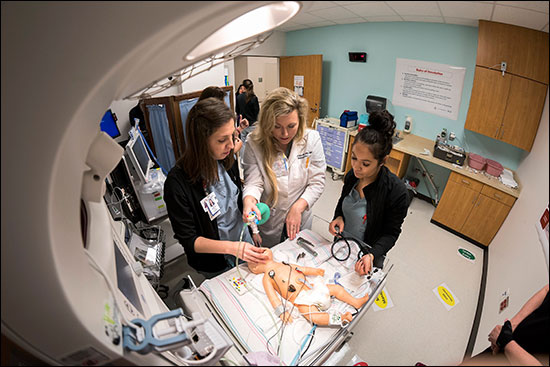
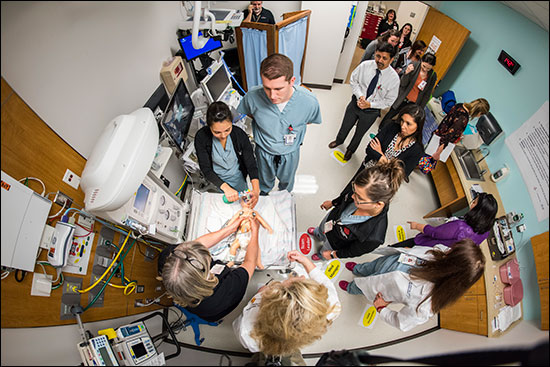
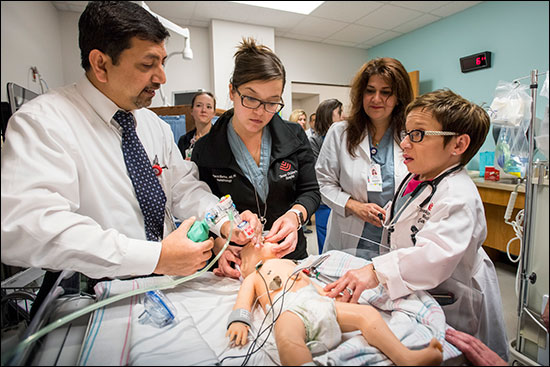
Texas Children’s Simulation Center hosted an open house to introduce Tory, a high-fidelity infant mannequin, and the newest addition to the first-ever Neonatal Comprehensive In Situ Simulation Program launched at the Pavilion for Women’s Newborn Center. The simulation equipment and supplies were purchased with a generous $200,000 grant from the M.D. Anderson Foundation, which will also support an in situ simulation program for the Emergency Center and Critical Care, as well as one for the NICU in West Tower once a dedicated space for simulation has been identified.

“We’re grateful to our Newborn Center leadership for dedicating a simulation room at the Pavilion,” said Dr. Jennifer Arnold, medical director of the Simulation Center. “Now, our NICU providers can train in their actual practice environments during regular workdays to enhance individual and team performance – particularly in high-risk situations – and improve patient outcomes and safety.”

The in situ simulation program focuses on improving crisis resource management skills, one of which is role clarity. During a code, the potential for confusion and chaos can easily set in as responders attempt to care for a patient in a high-risk medical emergency. Clinicians responding to a code may not always be sure of their roles or the roles of their team members when they arrive, and that’s when in situ simulation training becomes crucial to patient safety and care.

“First, we conducted tests to determine the necessary roles in a crisis, whether it’s a resuscitation or a code,” said Dr. Mona Khattab, one of the in situ simulation program directors for the NICU. “By having the necessary personnel at the code, we alleviate staff overcrowding and ensure optimal efficiency and clear communication are achieved while delivering lifesaving treatment to our NICU patients.”

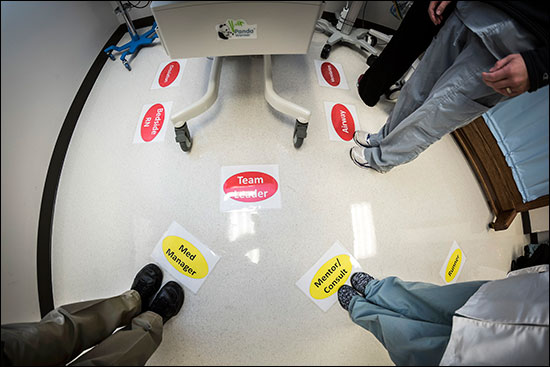
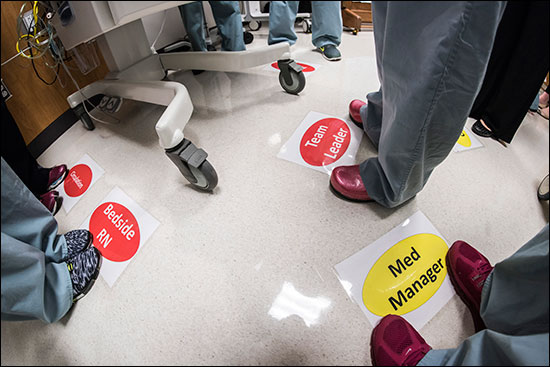
Inside the simulation room, colored labels – red, yellow and green – are affixed to the floor that encircle the bedside. These labels identify the specific roles of each of the code response participants and directs them to their position on the floor during a medical emergency.

  • The red team consisting of clinicians and nurses stand in the innermost circle closest to the bedside where they provide direct patient care.
  • The yellow team is positioned behind the red team. They support patient care providers by documenting the code, handing over equipment, managing the ventilator and medication and blood prep drawers, and providing mentorship and consultations to the team leader as needed.
  • The green team stands in the back of the room near the code cart and provides overall code and room support to ensure everything is running seamlessly.

“When a text message page is sent, the unit reports to the simulation room as if it were an actual page in the unit to respond to a code,” said Kellie Kainer, assistant director of Nursing for the NICU at the Pavilion for Women. “We give them a brief history of the patient and alert them to the code.”

The in situ simulations will occur every Thursday and last 10 minutes followed by 20 minutes of debriefing. The NICU teams alternate every week and are selected based on their current assignment and the flow of the unit on that particular day.

“We’re focusing on one specific patient case so that everyone gets exposure to that case,” said Dr. Leigh Ann Cates, a neonatal nurse practitioner and a program director for the in situ simulation program. “As our program expands, we hope it will become a model for in situ simulations in other units of the hospital.”

In preparation for this training, all clinicians within the Newborn Center complete an online pre-simulation course through Healthstream. The Simulation Center developed a series of powerpoint presentations covering crisis resource management skills, an orientation to simulation, and what to expect during simulation such as a confidential and psychologically safe learning environment.

22416lifesaving640When Dr. Natasha Afonso clipped in to a bike for a spin class on a recent Thursday evening, she didn’t know the skills she uses each day to treat patients in the CVICU would mean the difference between life and death for a fellow rider. Toward the end of the 45-minute, high-intensity class, Afonso heard commotion behind her as riders were being ushered out of the room. When she turned around she saw 50-year-old Scott Corron lying motionless on the ground.

She jumped off her bike and found Corron cold, clammy and pulseless. Because she didn’t see him fall, she thought he may be dehydrated, but because he wasn’t breathing Afonso immediately started CPR.

“It’s surprising to see someone go into cardiac arrest outside of the hospital setting,” said Afonso. “I didn’t have time to get my own heart rate down much less think about what caused Scott to stop breathing, so I started compressions.”

When the paramedics arrived 15 minutes after Afonso started CPR, she assisted with quickly placing the electrode pads on him. The paramedics shocked Corron before resuming compressions and he was fairly alert as the ambulance whisked him off to the hospital.

Corron, who has ironically worked in cardiology device sales for more than 20 years, credited Afonso’s quick thinking and action which has led to a full recovery.

“Words aren’t enough to thank Dr. Afonso for saving my life,” said Corron. “I hope to be back on the bike soon and am so thankful she decided to take a spin class that night.”

To see the reunion between Afonso and Corron, watch this recent NBC 2 KPRC story.

22416CVS640Texas Children’s works hard to minimize the impact of rising health care costs to our employees. That is why we have partnered with our prescription benefits manager, CVS/caremark to bring an additional benefit. Very soon those enrolled in the Texas Children’s Medical Plan will be receiving an ExtraCare Health Card that provides savings of 20 percent on all CVS/pharmacy brand health-related items. In addition, 2 percent back in ExtraBucks rewards will be awarded when using the ExtraCare Health Card.

That is a 20 percent savings everyday on thousands of items to help you on your path to better health. Think of all the non-prescription items you use on a regular basis in which you can take advantage of these savings, such as:

  • Allergy medicines
  • Cold medicine
  • Eye drops
  • First-aid supplies
  • Pain relievers
  • Vitamins

You will be able to use your card at any CVS/pharmacy location or online at www.cvs.com. Please note, only two ExtraCare Health Cards will be mailed per household. If you already have an ExtraCare Card from CVS/pharmacy, you can simply transfer your current rewards to your new ExtraCare Health Card and start enjoying the 20 percent savings. Savings will be automatically deducted off eligible health-care items.

Don’t forget that CVS/caremark has a mail-order program that offers you deeper discounts through bulk purchasing and no dispensing fees, which mean lower out-of-pocket pharmacy costs. For more information about the benefits offered at Texas Children’s, please visit TexasChildrensBenefits.org.

22416SSAngelinaRangelinside175Angelina Rangel of Nursing Professional Development is the latest Texas Children’s Super Star leader. “A super star is someone who is constantly striving to improve, constantly learning, working to be the best they can be as a person and as a coworker,” Rangel said. “Also this person takes ownership.” Read more of Rangel’s interview and find out how you can nominate a Super Star

Q&A: Angelina Rangel, October – December 2015 Leader

Your name, title and department. How long have you worked here?
Angie Rangel, MSN, RN, CCRN, LNC – Assistant Director of Nursing Professional Development. I have been at Texas Children’s Hospital for 24 years.

What month are you Super Star for?
October – December 2015

Tell us how you found out you won a super star award.
My leader set up a meeting to discuss events for the week. He asked me meet him in the conference room. When I arrived at the conference room, the entire team from Nursing Professional Development was there to surprise me with cake, food and gifts.

What does it mean to be recognized for the hard work you do? How has the organization helped you achieve your personal and professional goals?
I was touched and honored by this recognition. Prior to being employed at Texas Children’s, one of my personal goals was to find an organization where I felt good about going to work. A positive work environment gives any employee motivation throughout the day. I started my career at Texas Children’s as a registered nurse in the NICU-3 in 1991. Honestly I don’t remember a day when I did not feel valued and appreciated by my coworkers and leaders. In turn, I appreciate all of my colleagues as well. With the support of Texas Children’s Hospital’s tuition reimbursement program, I was able to go back to school for MSN/MBA and advance my career from bedside nurse to charge, preceptor, educator, manager and currently as the assistant director of Nursing Professional Development. In every role that I have held, I have felt appreciated and recognized for even the small things that I felt that really didn’t matter. Texas Children’s is a great place to work.

What do you think makes someone at Texas Children’s a super star?
Someone who is constantly striving to improve, constantly learning, working to be the best they can be as a person and as a coworker. Someone who takes ownership, and apologizes if appropriate. Someone who brings high energy, commitment and enthusiasms that causes others around them to respond positively.

What is your motivation for going above and beyond every day at work?
When one feels valued and appreciated, it is a natural motivation to go above and beyond.

What is the best thing about working at Texas Children’s?
As social beings, we naturally seek support from our peers and seek to belong to a group. I found the sense of unity with every team that I have had the privilege of working with at Texas Children’s. A strong team spirit. I appreciate the acceptance and tolerance of differences in perspectives and working styles between team mates. I especially am blessed to be working alongside my current teammates and leaders. There is such cohesiveness among this team.

What does it mean to you that everyone at Texas Children’s is considered a leader? What is your leadership definition?
It means that everyone has a voice. It means leading a life of action. Taking action in your own life, and making the changes that you want to see and focusing on the things you can control. Leadership is a style of persuading. It is about setting an example of inspiration and service. A true leader is a servant, ethical and authentic.

Anything else you want to share?
     Many years ago my father told me “if you want to be a leader, you need to be a servant”. Although at that time, I didn’t understand his statement. But later I understood exactly what he meant. The idea of servant leadership isn’t new. Robert K. Greenleaf first coined the term servant-leadership in a 1970 essay.
     In his works, Greenleaf discusses the need for a better approach to leadership, one that puts serving others – including employees, customers, and community – as the number one priority. Servant leadership emphasizes increased service to others, a holistic approach to work, promoting a sense of community, and the sharing of power in decision making. In his works, Greenleaf discusses the need for a better approach to leadership, one that puts serving others – including employees, customers, and community – as the number one priority. Servant leadership emphasizes increased service to others, a holistic approach to work, promoting a sense of community, and the sharing of power in decision making.
     Some of the characteristics of the servant leader are what I see in the leaders that I work with at Texas Children’s. I have seen the servant leader characteristics in the staff from environmental services to Mr. Mark Wallace. That is why this organization is where it is today. I thank God that I am part of this great organization with leaders who exhibit the philosophy and model of a servant leader. Some of the characteristics of the servant leader are what I see in the leaders that I work with at Texas Children’s. I have seen the servant leader characteristics in the staff from environmental services to Mr. Mark Wallace. That is why this organization is where it is today. I thank God that I am part of this great organization with leaders who exhibit the philosophy and model of a servant leader.