May 16, 2017

Hearing the words, “you’re pregnant” can be an exciting, life-changing moment. But for many couples struggling with infertility, the journey to parenthood is frustrating, stressful, and can at times feel hopeless.

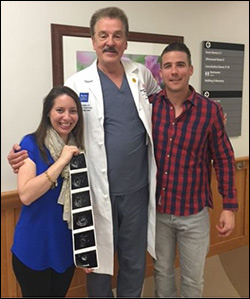
For almost two years, Brooke Schmitt and her husband, Daniel, struggled to start a family, but infertility issues got in the way of achieving their dream of parenthood.

“My OB/GYN ran several tests, and it turned out that my numbers were really low,” Brooke said. “Since my ovaries were not releasing eggs, my doctor recommended that I consult with a fertility specialist.”

After consultations with other providers, Schmitt chose the Family Fertility Center at Texas Children’s Pavilion for Women, a regional and national leader in providing advanced fertility services to families who have had difficulty conceiving.

Since opening in July 2014, the center’s reputation was strengthened even more in 2016 when its success rates for in-vitro fertilization (IVF) reached a milestone – 47 percent of embryo transfer patients at the Center achieved clinical pregnancy.

Dr. William Gibbons, chief of Reproductive Medicine at the Pavilion for Women and founding director of the Family Fertility Center, credits the Center’s success to numerous factors – state-of-the-art technology, research and support of Texas Children’s Hospital.

“Texas Children’s allowed me to have resources that many IVF programs don’t have,” Gibbons said. “They enabled us to build the absolute best lab that we could have, and we have almost as much research lab space as clinical lab space.”

The Family Fertility Center is the first in Houston and among the early adopters in the U.S. to offer the EmbryoScope, an embryo monitoring system that provides continuous moving time-lapse images of embryos as they grow. This technology allows fertility specialists to identify the healthiest embryo to transfer to the patient to improve IVF success.

Realizing the uncertainties that often accompany fertility treatments, the Schmitts relied on the Center’s expertise and state-of-the-art capabilities to help facilitate their dream of becoming parents. After consulting with their reproductive endocrinologist Dr. Paul Zarutskie, Brooke and her husband elected to pursue IVF.

“I was really lucky – my numbers were great,” Brooke said. “They retrieved about 41 eggs, and 39 of them fertilized successfully.”

At the end of day five, 12 of Brooke’s embryos were still living. All of them underwent genetic testing, and five of them were healthy. She and her husband, Daniel, implanted an embryo. The other four healthy embryos were cryogenically preserved for future implantation.

Brooke was implanted with an embryo on February 5, 2016. After undergoing blood work to confirm the couple was pregnant, the test came back positive.

Their daughter, Sophia, was born October 19, 2016.

“It’s a surreal feeling to know that you’re a parent and you’ve made this baby,” Brooke said. “We know we couldn’t have made her without the help of Dr. Zarutskie and the fertility team. Between the talent and the state-of-the-art technology there, it was a perfect combination that produced a perfect outcome.”

To read more about the Schmitts’ story in Texas Children’s Annual Report, click here. To learn more about Texas Children’s Family Fertility Center, click here.

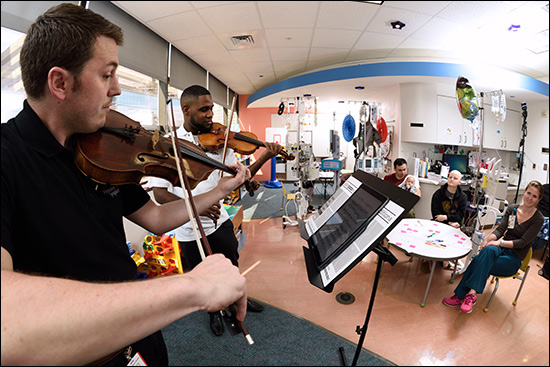
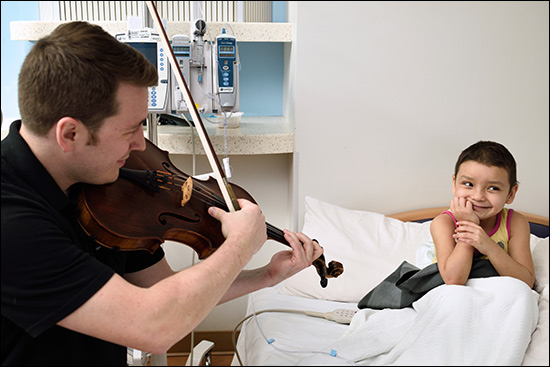
The moment Hellen Weberpal’s bow hit her cello, 13-month-old Kimberly Guerra was mesmerized. The little girl shot up in her seat in her inpatient room on the ninth floor of the Cancer Center and watched Weberpal as she played her instrument. During the 10-minute serenade, Kimberly smiled, giggled and clapped in joyous wonder.

Weberpal, a Houston Symphony Community-Embedded Musician, said she has had many experiences at Texas Children’s similar to the one she had with Kimberly.

“Every time I come to the hospital I enjoy it,” she said. “There’s never a day that I don’t have a good time getting to see these kids.”

Weberpal is one of four community-embedded musicians who come to Texas Children’s Cancer Center weekly as part of a partnership between the Periwinkle Arts In Medicine Program at Texas Children’s Cancer and Hematology Centers and the Houston Symphony. During their visits, the string players perform at the bedside of inpatients, lead a small music education class with patients and their siblings, and work with Purple Songs Can Fly to create unique scores tailored for each child.

View photos below from some of the musician’s visits.

The purpose of the partnership is to expose children to classical music and give them a sense of normalcy they often don’t get in a hospital setting, said Emily Nelson, the manager of education and community programming for the Houston Symphony.

“One of the benefits we’ve heard from the hospital staff and families is that the musical interactions give the patients a sense of control,” Nelson said. “They get to choose if they want slow music, fast music or even no music at all.”

When Weberpal visited 8-year-old Eduardo Castro’s hospital room, he asked her to play something fast, something slow and then something very specific – the music played in Star Wars when Darth Vader is on screen. Weberpal delivered Eduardo’s request without a hitch, concluding her visit with a smile and a high five.

“I’m always happy to meet another Star Wars fan,” Weberpal said.

Through observations, Carol Herron, coordinator of the Periwinkle Arts In Medicine Program, has noticed the encounters between the musicians and the patients are much more than a show-and-tell type performance.

“There’s a connection that these musicians make,” she said. “That is what makes these relationships so special.”

To learn more about the Houston Symphony’s Community-Embedded Musician initiative, click here. To learn more about the Periwinkle Arts and Medicine Program at Texas Children’s Cancer and Hematology Centers, click here.

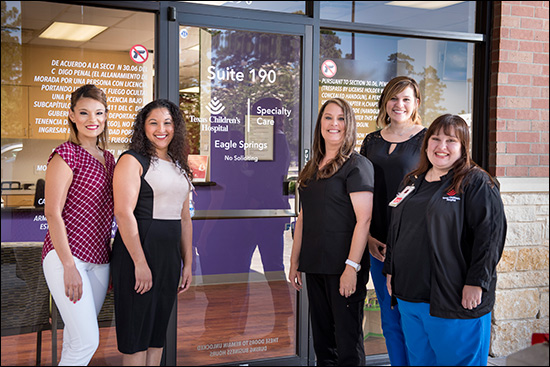
Texas Children’s joined forces with community leaders on May 5 to celebrate the opening of Specialty Care at Eagle Springs.

The clinic at 5514 Atascocita Road, Suite 190, in Humble is Texas Children’s newest pediatric specialty care clinic, offering convenient services to children and families in Humble and surrounding areas.

Services offered at the Eagle Springs location include:

  • Audiology
  • Otolaryngology (ENT)

Both services are available five days a week.

To make an appointment for Specialty Care at Eagle Springs, please call 281-666-5006.

Texas Children’s will continue to offer world-class care in the areas north of Houston at the health system’s Kingwood Glen location at 19298 West Lake Houston Parkway in the Kroger shopping center.

Services offered there are:

  • Cardiology
  • Full-Service Orthopedics
  • Sports Medicine
  • Pulmonology
  • Plastic Surgery
  • Pediatric Surgery
  • Allergy and Immunology
  • Urology
  • X-rays, EKG, ECHO, Ultrasound

To make an appointment for Kingwood Glen, please call 281-812-0280.

May 9, 2017

Texas Children’s recently received an impressive report card from The Joint Commission with surveyors commending the hospital for demonstrating several best practices.

“Our survey results are a great indication that we are meeting the expectation of quality care for our patients,” said Texas Children’s President and CEO Mark A. Wallace. “This should only propel us to continue our focus on providing safe, quality care every single day for every one of our patients.”

Every three years, Texas Children’s undergoes an accreditation process to ensure our delivery of high-quality patient care. On May 1, the Joint Commission survey team arrived at Texas Children’s for a 5-day unannounced survey. The surveyors consisted of an administrator, a pediatrician and ambulatory specialist, four pediatric and OB/GYN nurses, and a life safety engineer.

What Joint Commission noted

The survey is intended to assess the organization’s compliance in patient care areas that contribute to positive outcomes and to measure and improve performance. The Joint Commission team was very impressed with our improved outcomes in asthma, diabetes, radiology efficiency and flow, patient flow and surgical complications.

The team also identified several best practices observed during the survey including:

  • Time out processes across the system
  • NICU infection control practices
  • Error prevention technology in the anesthesia and pharmacy areas
  • Critical lab documentation
  • Simulation of new buildings and processes for latent safety threats

“The Joint Commission survey team visited several Texas Children’s facilities to evaluate patient care processes through on-site observations, staff interviews and tracer methodology,” said Texas Children’s Quality and Safety Director Elaine Whaley. “This year, Joint Commission implemented a new survey methodology called Survey Analysis for Evaluating Risk (SAFER), a matrix that uses a color-coded grid to evaluate the likelihood of harm to our patients, staff and visitors based on the number of occurrences.”

The surveyors were impressed with the knowledge and confidence exhibited by staff and faculty who participated in the tracer interviews. They complimented them on their ability to navigate Epic and explain the continuum of care, and they were impressed by our staff’s ability to talk about quality projects and outcomes.

How we prepared for the survey

Preparing for regulatory surveys is an ongoing process underscored by Texas Children’s daily focus on patient safety and high quality programs. Texas Children’s uses a consultant on an ongoing basis to review our processes and evaluate our survey readiness. The information provided by the consultant helps the organization fine tune.

“The results we get from area tracers during the preparation process provide information we need to develop and implement an organization-wide readiness education program,” said Danyalle Evans, Texas Children’s assistant director, System Accreditation and Readiness. “We regularly evaluate our internal processes against regulatory guidelines to identify opportunities for improvement. Regulatory surveys are valuable evaluation tools, but we have a deliberate focus on the quality and safety of our patients’ care every day.”

The Joint Commission accredits and certifies more than 20,500 health care organizations and programs in the United States. Approximately 77 percent of the nation’s hospitals are accredited by The Joint Commission.

Each year, Texas Children’s produces an annual report spotlighting the breadth, depth and growth of our organization. The report typically is in the form of a book that is mailed out to tens of thousands of our health care peers, government and community leaders, donors and other internal and external constituents.

This year we have a new way to share our experiences that will reach you and anyone with whom you wish to share it – the Texas Children’s Hospital online Annual Report. The report went live this week and is a dynamic representation of our growth and success in 2016.

Throughout the site, you will find articles, pictures, videos and graphics that highlight our patients, staff and growth. You also can hear directly from our President and CEO Mark Wallace in a video address about our year and what’s to come.

Each section of the site – news, notes and numbers – gives you an opportunity to experience how and why Texas Children’s health care system continues to get bigger and even better.

“At Texas Children’s, we are so passionate about our work and our mission that it is easy to get swept up in the incredible pace at which we move, build and expand,” Wallace said. “We get a lot done in the span of one short year, and 2016 was no different.”

Read all about it at texaschildrensannualreport.org. Share the link to the online report with friends and colleagues, and encourage them to do the same.

It’s appointment day. You park your car, arrive at the hospital and make a beeline to the elevators at the Wallace Tower hoping to shuttle your child to his or her doctor’s appointment on time. After dealing with traffic on your way in, you’re faced with another challenge – waiting patiently for an available elevator cab.

Based on recent Press Ganey patient satisfaction survey results, Texas Children’s Patient Experience Team has focused on several priority initiatives in FY17, one of which is to improve the elevator experience for patients and families who depend on the Wallace Tower elevators to take them to and from their clinic appointments.

“This has been a significant, on-going concern for our patient families,” said Katie Kalenda Daggett, director of Patient and Family Services. “We have partnered with Ambulatory Leadership, Facilities, Marketing, HR, Security Services and other teams from across the hospital to develop creative solutions to improve the patient and family elevator experience.”

Texas Children’s recently launched the Step Up for Patients First initiative, which encourages employees and staff to put patients and families first, from the time they arrive at work to the time they leave. This includes providing patients and families priority access to the elevators to reduce unnecessary wait times.

In the next few weeks, employees and staff will notice new, colorful wayfinding signage near the Wallace Tower elevators and stairwells, which have now been opened to patient and visitors who opt to take the stairs from Monday to Friday between 7 a.m. to 6 p.m. Employees may take the stairs any time, but are encouraged to take the stairs as often as possible.

“We want our patients to arrive at their appointments easily, and we encourage all Texas Children’s employees to be part of this collaborative process to reduce extended wait times at the elevators,” Kalenda Daggett said. “Step Up for Patients First is part of a broader initiative to enhance patient experience across the hospital system.”

Texas Children’s continually receives feedback from patient families about small changes that can be made across the system to promote a positive experience. Our broader initiative will include future improvement efforts, such as encouraging employees to step up for patients who are lost and need help with wayfinding.

If you have any suggestions for improvements or any additional feedback, contact the Patient Experience team at patientexperience@texaschildrens.org.

Step Up stairwell challenge begins June 1

In conjunction with Step Up for Patients First, Texas Children’s Health and Wellness will launch an organization wide Step Up stairwell challenge from June 1 to June 30 that will challenge employees and staff to Step Up for Patients First and make physical activity a priority. The Well-Being Team will be in the stairwells periodically to encourage employees on this new culture habit while handing out swag and fun incentives to celebrate stepping into good health.

Stay tuned to Connect for more details.

This year’s National Nurses Week theme is “Nursing: The Balance of Mind, Body and Spirit, and we’re celebrating our more than 3,000 Texas Children’s nurses who lead the charge for health and wellness every day.

To recognize our amazing nurses and their nursing colleagues around the country, May 6 through May 12 is designated as National Nurses Week. Each year during this time, we pause to recognize and applaud the successes, accomplishments and contributions that our nurses make to their patients and their profession.

The Nursing Retention Council has taken great pride in developing a schedule of events that are designed to ensure that nurses from across our system know how deeply valued they are. Saturday, May 6, kicked off an exciting week full of memorable events, activities and educational opportunities, including fun activities for nurses on their individual units.

On Tuesday, May 16, Connect will feature event highlights from Nurses Week, including special recognitions of our 2017 Nursing Excellence Awards winners as well as our nurses who have been recognized among the Houston Chronicle Salute to Nurses Top 150 and Top 10.

For a complete schedule of Nurses Week activities, click here and to view the recent By the Numbers flyer spotlighting Nursing at Texas Children’s, click here.