September 12, 2017

A 4-year-old child undergoes a Fontan procedure to correct a heart problem. The child’s medical team is unaware that the proposed post-surgical plan of care may endanger not only the patient but also the patient’s family – and is also financially wasteful. If the care team is unaware of these potential risks, how can they offer the patient and patient’s family the best, most appropriate care that yields the best possible outcomes?

As one of the top five pediatric hospitals in the country, Texas Children’s cares for many patients with a number of medical conditions. Across our hospital system, care teams follow clinical standards related to specific medical conditions to ensure the best care is delivered to the right patient at the right time, leading to improved long-term outcomes.

“Clinical standards provide a way to align our clinicians, families and other organizations with a more streamlined approach to improve the safety, quality and cost efficiency in the delivery of patient care,” said Dr. Charles Macias, chief clinical systems integration officer at Texas Children’s and director of the Center for Clinical Effectiveness and Evidence Based Outcomes Center. “By allowing this type of standardization, hospitals can minimize wasteful expenditures caused by medical errors and ordering of unnecessary tests which can lead to inefficiencies in health care.”

From developing patient care guidelines for post-surgical care to treating common conditions like asthma and diabetes – among many other clinical conditions – our health care teams rely heavily on the instrumental work of Texas Children’s Evidence Based Outcomes Center (EBOC). The team reviews and translates scientific evidence into clinical standards that detail the essential steps in the care of patients with a particular clinical condition.

“Once a specific disease is selected, our team conducts a thorough review of evidence using the GRADE methodology,” said EBOC Research Specialist Andrea Jackson. “We review clinical questions and assess potential benefits and harms of different treatment options. We guide multidisciplinary teams to incorporate clinical expertise from our physician and nursing partners as well as input from patient family advocates on their own experiences into the development of practice recommendations based on available evidence regarding the specific clinical condition.”

Since the opening of the EBOC in 2010, the team has developed 95 clinical standards, some of which have led to publications in peer-reviewed health journals. In addition to the Connect website, Texas Children’s clinical standards for medical conditions are available here on the Outcomes and Safety external site.

“We are adding new clinical standards to that site about every three months,” said Anne Dykes, assistant director of Texas Children’s Outcomes and Impact Service. “All 10 years’ worth of work that we’ve built internally to help our own clinicians and those across our system, we’re now making available to the public. These standards are not just for physicians, clinicians and administrators at other hospitals, but also for patient families to help them understand the essential steps in the care of patients with a particular condition.”

The center also provides an evidence-based practice course that has educated more than 150 health care professionals on how to develop practice guidelines. Since 2007, more than 300 physicians, 275 nurses along with many of our patient family advocates have participated in guideline developments to enhance patient outcomes.

Additionally, the EBOC has launched a national collaborative with 11 other children’s hospitals to bring clinical standardization across the nation.

“Through this strategic collaboration, we are identifying where clinical standards could be done in unison so that we could all share in our products and still offer an opportunity to tailor them to our own individual institutions,” Macias said. “We have a national need for the science of it and a local need for the process of care delivery.”

Click here for a complete list of the EBOC’s 95 clinical guidelines developed to treat specific medical conditions.


Leticia Sowell, Patient Care Assistant, Cardiology Inpatient Unit, passed away on August 12, 2017 at the age of 41.

Leticia loved caring for patients on the West Tower 15 Cardiology Inpatient Unit for nine years.

Leticia leaves behind four children: Caylin, Mya, Warren and Niecy to cherish her memory.

September 11, 2017

It’s hard to believe that less than a week ago Hurricane Harvey slammed into the Greater Houston area dumping foot after foot of rain into our communities’ streets, homes and businesses. Since then, people across the region – including many employees at Texas Children’s – have been working around the clock to try and put their lives back together again.

Many of those directly affected by the storm are looking for help, and many of those who were spared by the storm’s wrath are more than willing to lend a helping hand. As you move forward with your recovery efforts, please remember there are guidelines Texas Children’s employees must follow when seeking and receiving aid.

One most important guideline to note pertains to the use of the Texas Children’s name and/or logo. Using the organization’s name and/or logo is not allowed when soliciting funds or other types of help unless the request is done in an official capacity. Therefore, individual employees should not mention Texas Children’s or their employment with the organization when seeking aid whether it be via an email to colleagues, a GoFundMe page, an Amazon Wish List or a post on social media.

Additional guidelines about giving and accepting gifts in your role at Texas Children’s can be found here.

“We understand that many of our employees are suffering due to the storm and are in need of help, however it is important that everyone follows our policy to not use the Texas Children’s name or logo in any way other than in an official capacity,” said Director of Risk Management Melissa Murrah. “There are many other ways to seek help and offer aid, such as donating to our Employee Financial Assistance Fund.”

Many Hurricane Harvey relief opportunities can be found here and include ways to donate money to employees affected by the storm, how to apply for employee assistance funds and an Employee Resource Network developed to help employees with needs related to Hurricane Harvey and connect with employees who would like to volunteer their services of a resource.

If you have a question about giving or receiving gifts pertaining to the storm, please contact Compliance and Privacy (ext. 4-2085 or compliance@texaschildrens.org).

September 8, 2017

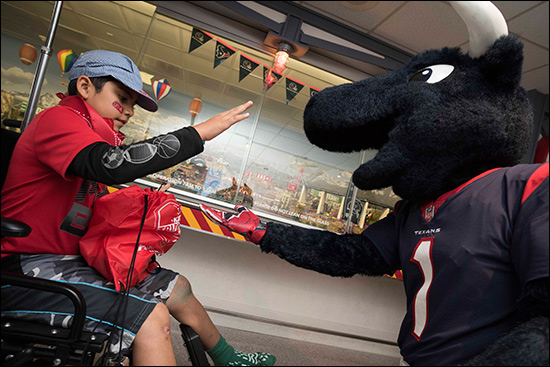
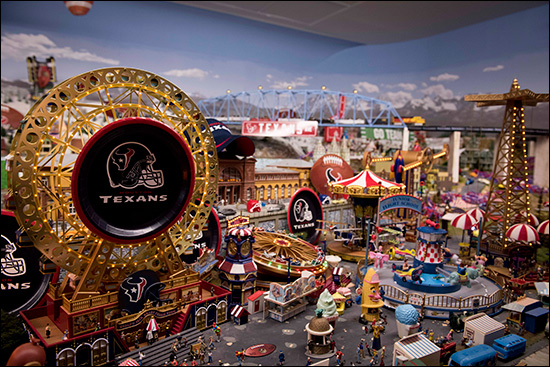
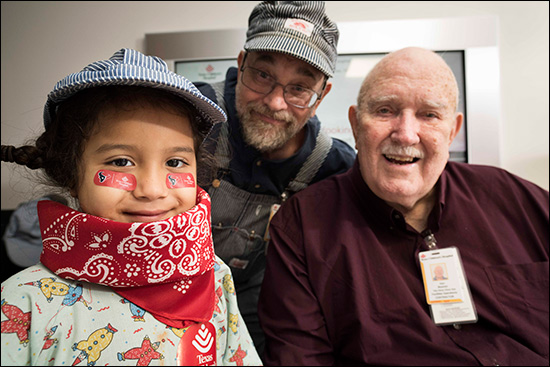
Some Texas Children’s patients recently got the chance to kick off the upcoming Houston Texans season right by attending a special event near the Choo-Choo Hut just inside the entrance of the Abercrombie Building.

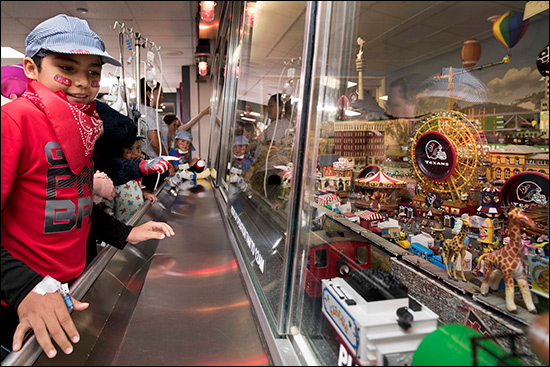
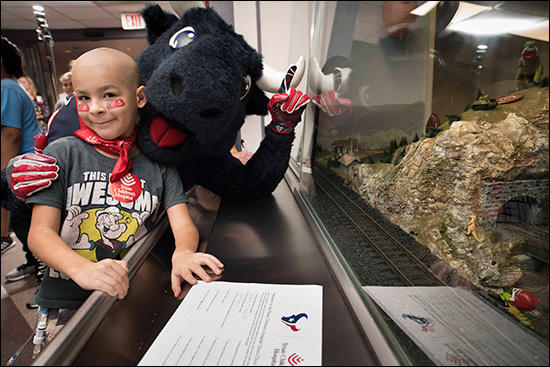
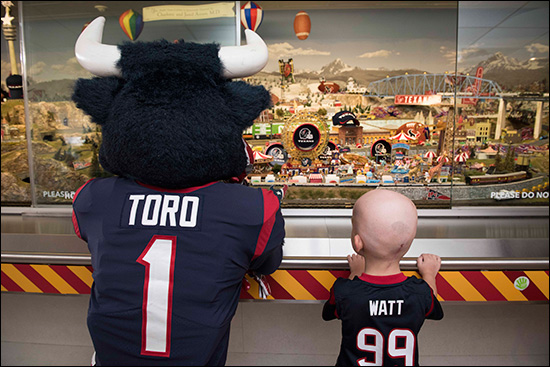
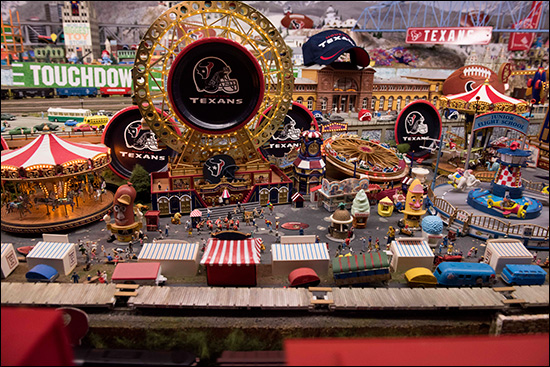
On the count of three, the children peeled a sheet of paper off of the large glass windows that encases the intricate model train exhibit. Behind the window was an exhibit transformed into a Texans wonderland.

See photos from the event below.

“Oh, my goodness!” screamed 8-year-old Alejandro Mendoza as he pointed to a pile of footballs inside one of the trains carriages. “Wow!”

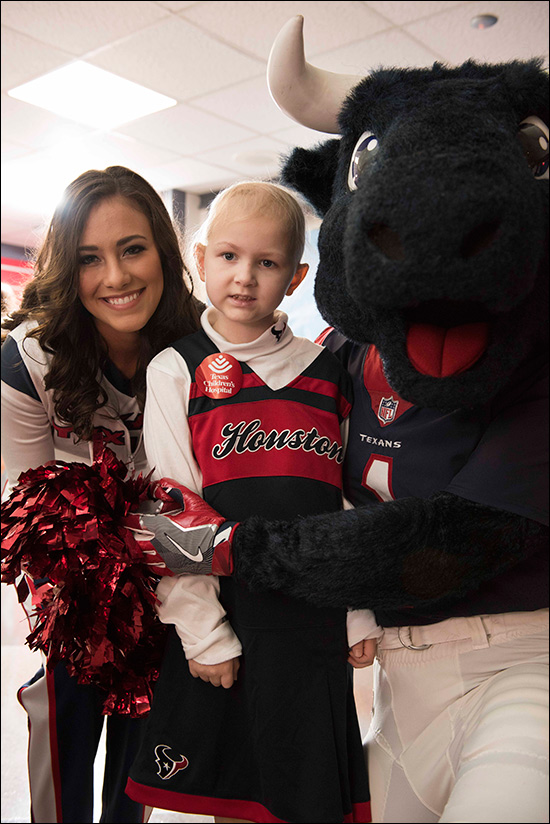
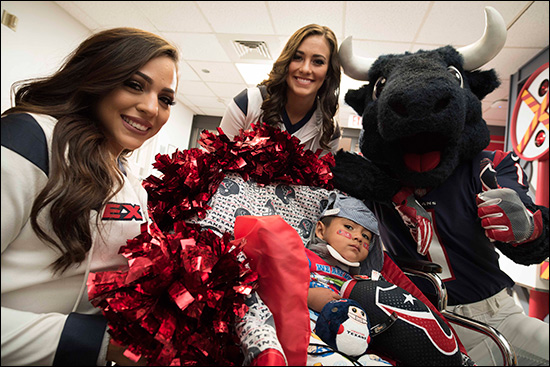
In addition to getting an up-close-and-personal look at the train decked out in Texans helmets, flags, banners, footballs and more, patients got to visit with two Texans cheerleaders, Ana Karen and Alexys, as well as Toro, the Texans lively mascot.

Dressed in her Texans cheerleading outfit, 6-year-old Claire Kochenowermet was especially excited about seeing Toro, one of the only Houston sports mascots she hasn’t had the pleasure of meeting.

After posing for a photo with Toro, Claire bashfully nodded her head when she was asked if she was enjoying herself. Her mother, Jodie Kochenowermet, said it was nice to see her daughter smiling and having fun.

Alejandro’s mother, Maria Sanchez, said her son has been at Texas Children’s for a month and does not get the opportunity to leave his room very often. So, to see him not only get to leave his room, but to do so for such a special event “feels really good.”

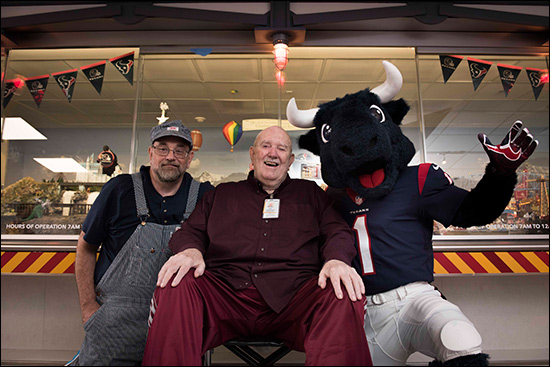
Don Bozman, the professional model builder hired to construct the train at Texas Children’s Hospital, still helps manage the maintenance of the train and attended last week’s event.

“The smiles on the faces of the patients and their families is what keeps me wanting to do this,” Bozman said. “It’s great to see them all so happy.”

Come check out the train yourself! It will be decorated in Texans gear until Halloween.

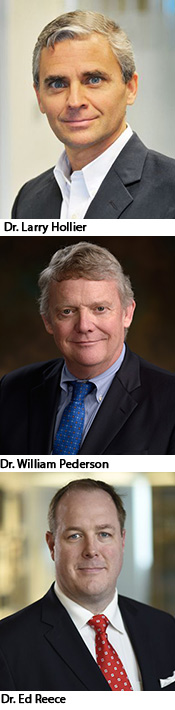
Dr. William Pederson has been named the Samuel Stal, MD Endowed Chair in Plastic Surgery, and Dr. Edward Reece has been named the Josephine Abercrombie Endowed Professor in Plastic Surgery Research.

“Both Dr. Pederson and Dr. Reece are exceptionally worthy recipients of these endowed positions,” said Dr. Larry Hollier, associate surgeon-in-chief for clinical affairs and chief of Plastic Surgery at Texas Children’s Hospital, and chief of Plastic Surgery at Baylor College of Medicine. “We are very fortunate to have received endowment funding from generous donors and hospital leadership in order to recruit and retain the most talented surgeons to care for our patients.”

Samuel Stal, MD Endowed Chair in Plastic Surgery

The Samuel Stal, MD Endowed Chair in Plastic Surgery was created through the contributions of Texas Children’s Hospital to honor the legacy of Dr. Samuel Stal, who served as chief of Plastic Surgery at both Texas Children’s and Baylor College of Medicine. For more than 30 years, Dr. Stal focused his Texas Children’s practice on helping children with craniofacial, cleft lip and palate deformities. He also created the Texas Children’s Center for Facial Surgery, which accepted all children with facial deformities regardless of their family’s ability to pay.

Pederson is a highly regarded hand and microvascular surgeon with faculty appointments in plastic surgery, orthopedics, neurosurgery and pediatrics at Texas Children’s and Baylor. His clinical interests include the management of vascular problems in the upper extremity, nerve injury and repair including brachial plexus, Volkmann’s ischemic contracture, facial paralysis and microsurgical reconstruction of complex extremity defects.

A leader in his field, Pederson currently serves as president of the American Association for Hand Surgery. Pederson was named a director of the American Board of Plastic Surgery in 2013 and is the chair of the Board’s Hand Surgery Examination Committee. He also serves as a member-at-large on the executive council of the World Society for Reconstructive Microsurgery. He has served as president of the American Society for Reconstructive Microsurgery and has served on the executive council of the American Society for Surgery of the Hand.

Pederson has authored more than 70 papers in peer-reviewed literature and 40 textbook chapters. He is an editor of the textbook “Green’s Operative Hand Surgery,” and serves on the editorial boards of the “Journal of Hand Surgery” and the “Journal of Reconstructive Microsurgery.”

Josephine Abercrombie Endowed Professorship in Plastic Surgery Research

The Josephine Abercrombie Endowed Professorship in Plastic Surgery Research was established by Ms. Abercrombie’s son, George Robinson, to honor his mother and the Abercrombie legacy of giving to Texas Children’s and Baylor. J.S. Abercrombie, Josephine’s father, was one of the founders of Texas Children’s Hospital.

Reece is the chief of Adult Plastic Surgery at Baylor College of Medicine. He specializes in plastic surgery and surgery of the hand. He is also a member of the Hand Surgery Program at Texas Children’s.

After earning a medical degree and Master’s degree in applied anatomical sciences at Case Western Reserve University School of Medicine, Reece completed his plastic surgery residency at UT Southwestern in Dallas. He went on to train under Dr. David Green at UT San Antonio in hand surgery and microvascular reconstructive surgery. He also earned an Executive MBA degree with an additional certification in health care supply chain from Arizona State University.

Reece conducts research in the areas of peripheral nerves, reconstructive surgery and telehealth as it relates to improving doctor-patient interactions and coordinating efficient care and affordable cost. He has founded several biomedical companies that seek to find efficiency and cost savings for institutions while preserving the highest quality to patients.

Three Endowed Positions in Plastic Surgery

This is the third endowed appointment for the Division of Plastic Surgery at Texas Children’s. Hollier holds the S. Baron Hardy Endowed Chair in Plastic Surgery. Dr. S. Baron Hardy was the first chief of Plastic Surgery at Texas Children’s. The endowment was gift from the T.L.L. Temple Foundation and was championed by Temple Webber, who serves as a T.L.L. Temple Foundation trustee.

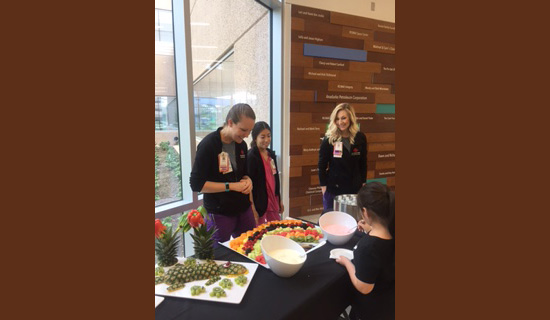
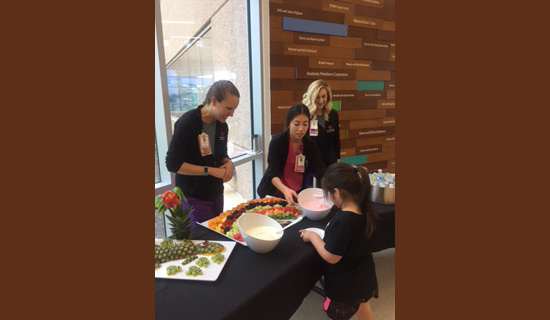
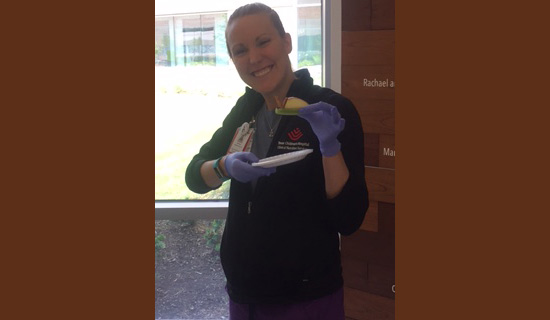
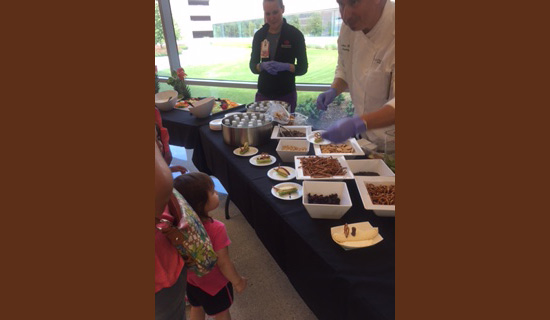
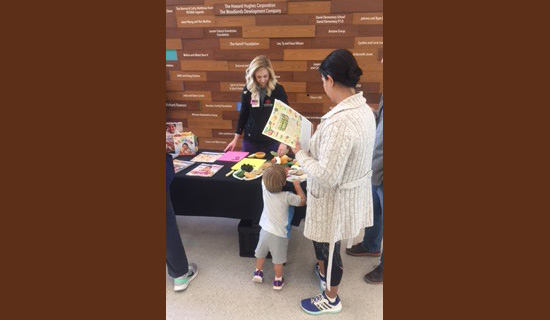
Texas Children’s Hospital The Woodlands had an excellent turnout of families at its first celebration of Kids Eat Right Month.

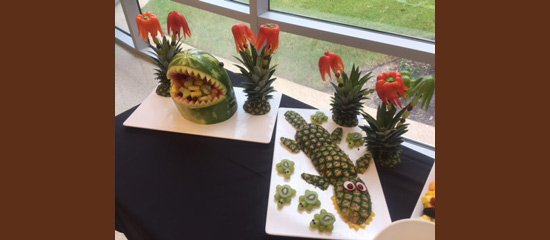
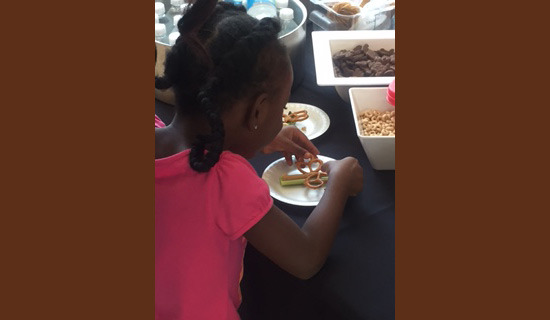
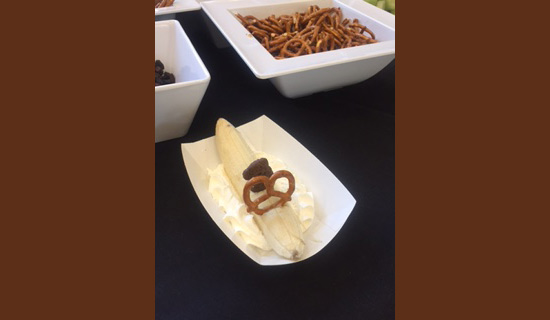
Working together, Food and Nutrition, and Clinical Nutrition Services encouraged children and their families to create and enjoy their own food art. Children learned how to make their own snails, butterflies, or banana race boats using healthy foods.

Chef Luis also prepared an edible rainbow of colors to remind children the importance of eating various types of foods. Even the pickiest eaters couldn’t resist!

Educational material and hands-on learning opportunities also were available to help teach kids how to build a healthy plate.

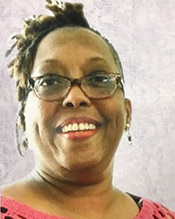
Frances Mathews, Clerical Secretary, West Tower Post Anesthesia Care Unit, died July 22, 2017 at the age of 55.

Frances’ career in the medical field spanned over 25 years between Texas Children’s Hospital and St. Luke’s. She had a passion for singing and was the lead singer for Ms. Frances & The Rhythm Fish and The Works. She was a bold, sweet spirit with a big heart. Her smile could light up a room, and her laughter was contagious.

She is survived by two children, Ray and Cachet; four grandchildren, Jaeden, Angeloe, Rayven and Christian; father Rufus; four sisters and three brothers; many other relatives, friends and church members from The Fountain of Praise.