September 26, 2017

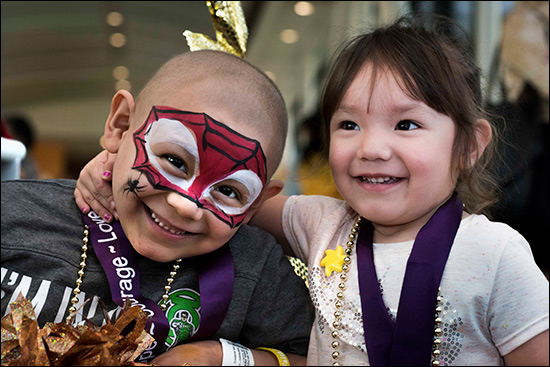
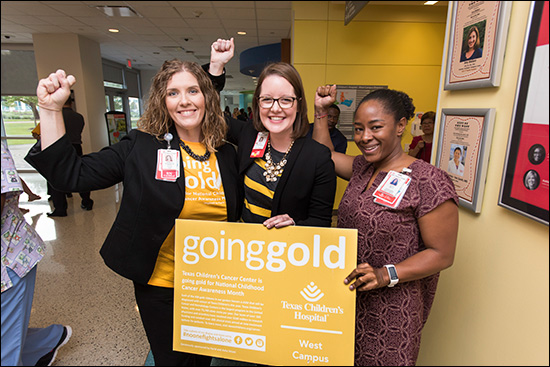
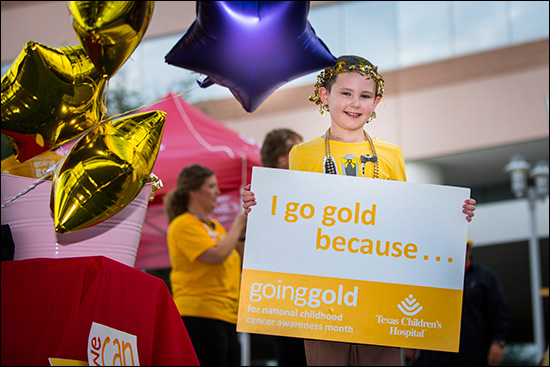
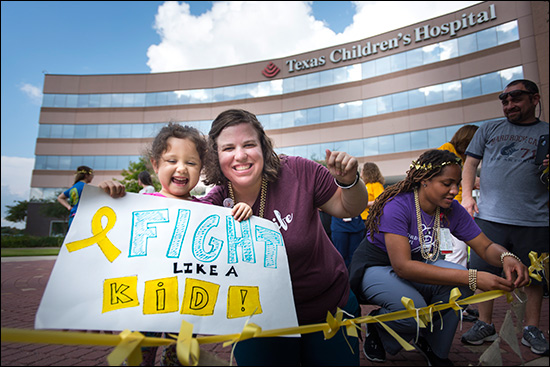
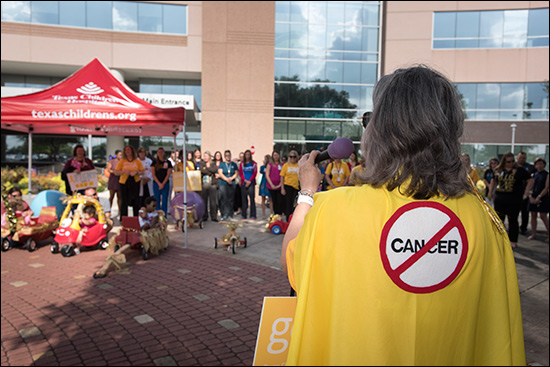
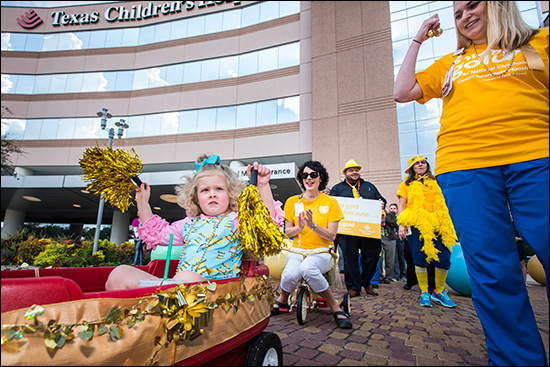
System wide Texas Children’s Cancer Center showed their “Going Gold” spirit throughout the month of September in honor of National Childhood Cancer Awareness month.

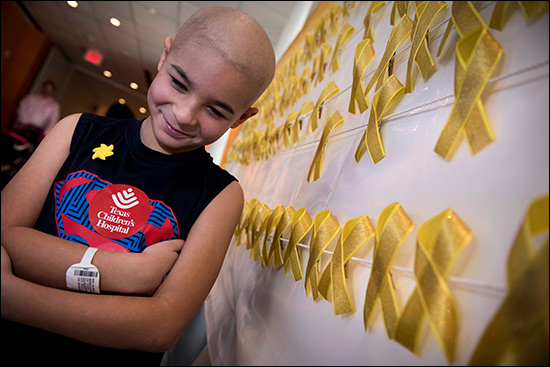
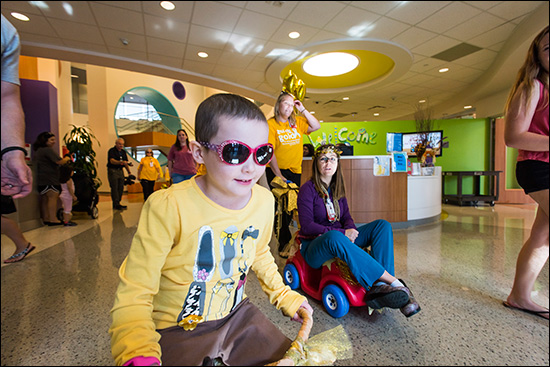
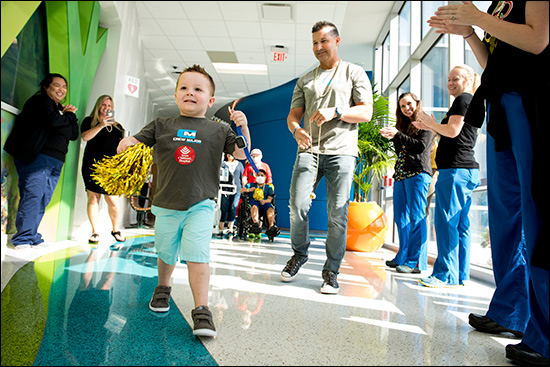
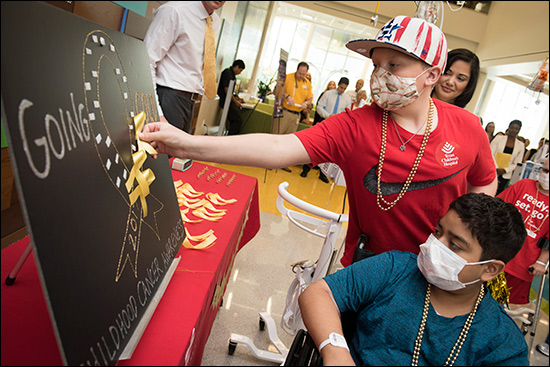
Patients, families and Texas Children’s Cancer Center employees wore everything gold, the official symbolic color for childhood cancer awareness, and participated in Going Gold parades, ribbon tying events and other festivities at our Main Campus in the Medical Center, Texas Children’s Hospital West Campus, Texas Children’s Hospital The Woodlands and Vannie Cook Children’s Cancer and Hematology Clinic in McAllen, Texas.

View a photo gallery from the events below.

Dressed in bright gold shirts and donned with gold stars, hats, necklaces, bracelets and other festive gear, participants marched for the worthy cause. Vendors from organizations such as the Periwinkle Foundation were present at all three events offering additional support to patients and families. And, in partnership with the Periwinkle Arts in Medicine Program, representatives from Purple Songs Can Fly showcased a beautiful song – Go Gold – written and produced just for the special occasion.

“Over the years, there have been significant advancements in oncology, making what was once a fatal diagnosis survivable here in the United States,” said Dr. Deborah Shardy, associate clinical director, Texas Children’s Cancer and Hematology Centers, West Campus. “However, there is still much more work that needs to be done, which is why we are here today.”

Texas Children’s Cancer Center was inspired to “Go Gold” three years ago by a young patient, Faris D. Virani, who was perplexed as to why he didn’t see as much gold in September as he saw other colors in months representing other diseases. Motivated by Faris’ concern, each year the Cancer Center has increased their level of “gold-ness.”

“Going gold is a way for us both to honor the courageous journeys of our patients and families who have been touched by pediatric cancer and to create awareness on a national level about the challenges these children face,” said Dr. David Poplack, director of Texas Children’s Cancer and Hematology Centers.

“Personally, the Going Gold campaign is a reminder that each day in our Cancer Center, all our dedicated staff members, including physicians and nurses, researchers, technicians and our support personnel, are diligently looking for ways to improve the cure rate for childhood cancer. We will not quit until we find a cure for every child with cancer and are able to prevent these diseases altogether.”

Faris’ mother, Asha Virani, said she knows her son, who lost his battle with Ewing’s sarcoma, is smiling because of all of the gold that was shown around Texas Children’s in September.

“This has truly been a golden moment” she said after the parade at Main Campus. “I would love for this to spread to other hospitals across the nation and the rest of the world.”

By the end of this year, it is estimated that over 15,700 children nationwide will be diagnosed with a form of pediatric cancer. Please help spread the message that Texas Children’s Cancer Center is leading the battle against pediatric cancer. To learn more about Texas Children’s Cancer Center, please visit http://www.txch.org.
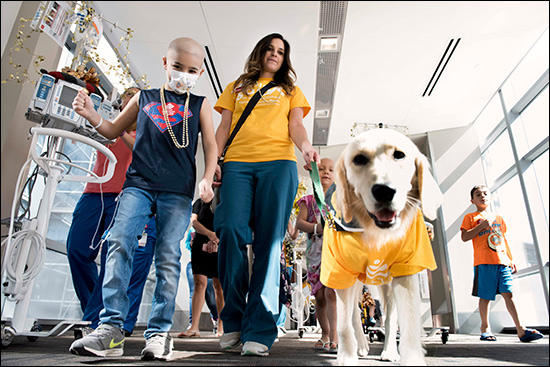
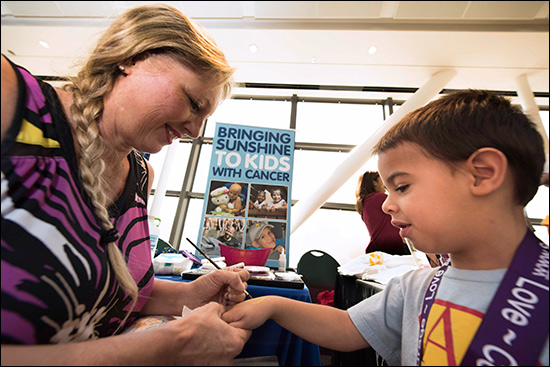
At Texas Children’s, we know just how important it is to keep the patient and family’s experience at the forefront of everything we do. Enhancing the experience for every patient and family who walks through our doors to receive care remains our top priority.

“We collect feedback year-round from our patient families to better understand how they experience their care with us, as well as to compare Texas Children’s experience with that of similar women’s and children’s hospitals across the country,” said Texas Children’s Director of Patient and Family Services Katie Kalenda Daggett. “The improvement initiatives and activities implemented across the Texas Children’s system are directly tied to what they tell us through the surveys.”

Starting on October 1, 2017, Texas Children’s will implement several new changes to the Patient Satisfaction Survey in response to feedback from patients, families, staff and providers. These enhancements will make the survey process more convenient for patient families and will provide specific actionable insight on what we do well and on where we have opportunities.

There are several survey improvements that will be implemented in FY18:

  • All phone surveys will transition to e-surveys. E-surveys will give families the opportunity to provide feedback almost immediately or when it is most convenient for them. This will make data more timely for teams. Patient families will also have the opportunity to provide feedback via their mobile devices. The e-survey will be available in two languages – English and Spanish – which will allow staff to receive feedback from the majority of Texas Children’s patient population. Through e-surveys, employees and staff will have the opportunity to survey 100 percent of the eligible patient population.
  • Survey questions will be condensed with the exception of inpatient surveys. Instead of 20 to 60 questions, the e-surveys will consist of 15-20 questions. Survey questions are selected based on their correlation to the patient’s overall satisfaction, the ability to take action, unit-level importance and Magnet reporting. By only asking questions that matter most to patients and their families, the goal is to achieve a better use of patients’ time when completing the survey.
  • Transition to CAHPS survey: Pediatric and adult inpatients will receive a Consumer Assessment of Healthcare Providers and Systems (CAHPS) survey upon discharge. The Leapfrog Survey and other regulatory bodies use HCAHPS to measure patient satisfaction. This adjustment will allow Texas Children’s to benchmark the experience of care with others across the nation.
  • Transition to NICU survey: Parents of patients in our Newborn Center will receive a NICU specific e-survey which provide meaningful questions pertaining to the hospital’s NICU population. This survey will allow our NICU to benchmark patient experience scores with other NICU’s across the nation.

In addition to these improvements to patient satisfaction surveying, Texas Children’s will transition to top box for goal setting and data reporting. Considered the industry standard for measuring patient satisfaction, top box is the percentage of respondents who gave the most positive response on the survey scale, such as “very good,” “yes,” or “always” – depending on survey type.

“Patient satisfaction goals will transition from a mean score to top box percentile which is simpler and more concise than a mean score,” said Aileen Rago, assistant director of Patient and Family Services. “Data, reports and unit goals will look different, as top box will be used in place of the mean score. A top box score of 67 percent means that 67 percent of patients/parents responded “very good” to the survey question. Essentially, top box will showcase how consistently we deliver on the experience at Texas Children’s.”

While these changes will take time to get used to, these improvements will provide employees and staff with more timely, meaningful data and benchmarking to ensure we create the best experience for our patients and their families.

“Patient and family experience at Texas Children’s is inclusive of the medical care we provide at the bedside,” Kalenda-Daggett said. “It is a reflection of our partnership with the patient and family. Everything we do revolves around our patients and families being heard and responded to. With these changes, we will be able to survey more of our patients in ways that works best for them; in turn we will better understand the needs of our patients and families, and respond compassionately.”

Anita Kruse, executive director of Purple Songs Can Fly, and Lisa Sheinbaum, owner of Art For All, recently joined efforts to publish a book benefiting Purple Songs Can Fly, a program that provides a musical outlet for children being treated for cancer and blood disorders at Texas Children’s Cancer and Hematology Centers.

Titled ‘Purple Song,’ the book was written by Kruse and illustrated by Sheinbaum. Through their words and pictures, the women produced a story about Purple Song, a little purple companion shaped like a treble clef with wings who shows readers how to sing their way through their troubles.

“‘Purple Song’ lets you see that friendship can emerge into beautiful melodies,” Kruse said. “We want readers to join Purple Song as she lifts them up and shares her connection to the power of music.”

Published by LongTale Publishing, a portion of the books proceeds will go to Purple Songs Can Fly. You can purchase ‘Purple Song’ at Texas Children’s gift shops and retail outlets such as Amazon and Barnes and Noble.

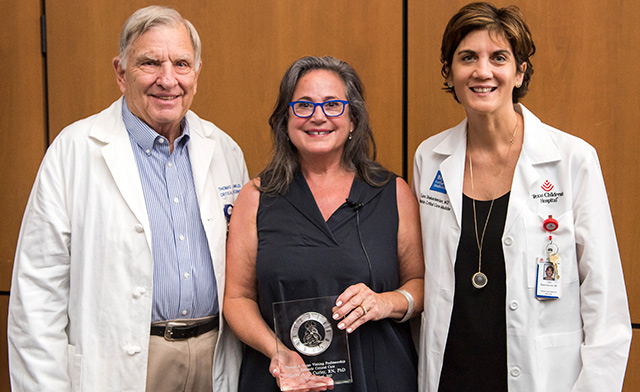
On September 22, Dr. Martha Curley, the 2017 recipient of the Thomas Vargo Visiting Professorship in Pediatric Critical Care Medicine, presented two lectures to residents, fellows, APP’s, physicians and nurses during her visit to Texas Children’s including Pediatric Grand Rounds  titled “Team Science – Answering Complex Clinical Questions Together.”

Curley is the Ellen and Robert Kapito Professor in Nursing Science at the University of Pennsylvania School of Nursing. She also holds a joint appointment in Anesthesia and Critical Care Medicine at the University’s Perelman School of Medicine and is a nurse scientist at Boston Children’s Hospital.

Through several decades of outstanding high quality nurse-led research that engages all members of the clinical team, Curley has transformed the ICU experiences and outcomes of countless critically ill children and their families all over the world.

September 19, 2017

Since the topping out celebration of Texas Children’s Legacy Tower nearly seven month ago, significant construction milestones have been reached inside the tower’s 400-foot-tall structure at Texas Children’s Medical Center campus.

Carefully designed to promote the safest possible environment to care for our most critically ill patients and their families, construction is underway on the patient care rooms in the cardiovascular intensive care unit (CVICU), pediatric intensive care unit (PICU) and the progressive care unit (PCU). Last year, a series of patient care simulations were conducted to identify and eliminate any latent safety defects in the final design of the critical care tower before actual construction began.

Based on helpful feedback from our providers and patient families, the size of the critical care rooms inside the Legacy Tower will be between 350 to 450 square feet – three times the size of the hospital’s current ICU rooms. The rooms will feature a dedicated family space, a bathroom and shower, and care teams will have enhanced visibility and monitoring between patient rooms and into the patient rooms from the nurses’ work stations. The ICU rooms also will be equipped with state-of-the-art technology including a boom that will provide gas, power and data from the ceiling.

“Booms allow us to position the patient almost anywhere in the 360-degree circle,” said Chief of Critical Care Medicine Dr. Lara Shekerdemian. “This means that we can use some very state-of-the-art equipment for mounting all of the pumps, monitors and ventilators at the patient’s bedside while keeping the equipment off the floor.”

The Legacy Tower’s high intensity operating rooms and intraoperative state-of-the-art MRI suite also will provide dedicated subspecialty care for surgical patients.

“Our pediatric surgical patients are different than other ICU patients,” said Texas Children’s Chief of Plastic Surgery Dr. Larry Hollier. “For the first time, we’re going to have them in a setting where the care is designed specifically for that surgical patient, and that’s going to be located one floor above the operating rooms. The new tower will help us increase our OR capacity so we are not turning patients away from receiving critical care.”

The Legacy Tower will open in two phases. The first phase will occur in May 2018 when the PICU, PCU, operating rooms and Radiology open. A few months later, the Heart Center will move into the new tower in August 2018.

The 25-floor Legacy Tower will house 126 beds for pediatric and cardiovascular intensive care, six new operating rooms (ORs) with the latest technology to complement the hospital’s existing 19 ORs, and will be the new home of Texas Children’s Heart Center, including the outpatient clinic, four cardiovascular ORs and four catheterization labs. This vertical expansion will help reinvest in the programs needed to provide the highest level of care to our most critically ill patients.

“I don’t know of any other children’s hospital in the country that has the type of experience that Texas Children’s has in bringing all of these elements together,” Hollier said. “With larger, more functional spaces, we will be able to provide patients and families with the best possible environment to receive care.”

Chief nursing executives and chief nursing officers play a crucial role in a hospital or health systems’ success. Many top nursing executives oversee large teams of nurses to ensure quality of care and patient experience.

Texas Children’s Chief Nursing Officer and Senior Vice President Mary Jo Andre was recently recognized as one of the “60+ Hospital and Health System CNOs to Know” for 2017 by Beckers Hospital Review, the leading source of cutting-edge business and legal information for healthcare industry leaders.

Andre joined Texas Children’s as a staff nurse and held several leadership positions, including senior vice president over quality and safety, before being promoted to CNO in 2015. Andre led the hospital’s efforts to improve its quality program, which yielded better patient safety and engagement.

Click here to read the Becker’s Hospital Review article.

September 12, 2017

Each year in September, Texas Children’s Cancer Center goes gold to honor the courageous journeys of our patients and families who have been touched by pediatric cancer and to create awareness about the challenges these children and their loved ones face. It is also a special time to honor the Cancer Center’s staff and everyone involved in the care and support of those who come to Texas Children’s seeking our aid.

Today, you will hear from patients, family members, doctors and other medical staff as they explain why they Go Gold in September and what makes raising awareness about pediatric cancer so important. Throughout the month, there are several events scheduled across the organization geared toward raising awareness about childhood cancer. Some of those event are listed below. Please check the Connect calendar and the Cancer Center’s Facebook page for additional details.

Upcoming cancer awareness activities:

  • September 7-30 – Smart Financial Center in Sugar Land will be lit gold
  • September 12 at 10 a.m. – Main Campus Going Gold Parade/Ribbon Tying and Purple Songs Can Fly Book release in clinic
  • September 16-19 – Houston City Hall will be lit gold
  • September 16 – Sickle Cell Education and Research Day and Purple Songs Can Fly book release at River Oaks Bookstore
  • September 20 at 10 a.m. – The Woodlands Going Gold Parade and Ribbon Tying Event
  • September 21 at 10 a.m. – West Campus Going Gold Parade and Ribbon Tying Event
  • September 25-29 – Global Idiopathic thrombocytopenic purpura (ITP) Awareness Week (concluding with September 29 as “Sport purple for platelets day”)
  • September 27-28 – Ewing Sarcoma Conference

To learn more about Texas Children’s Cancer Center, click here.