The story you are about to read is part of an ongoing series about Texas Children’s efforts to care for women and children around the globe. The series highlights Texas Children’s efforts in Malawi and Colombia, two of the 17 countries we currently serve. Today’s story focuses on Baylor College of Medicine International Pediatric AIDS Initiative at Texas Children’s Hospital and its network of Centers of Excellence that have saved a generation of children and young mothers from the ill effects of and possibly death from HIV/AIDS.
Phoebe Nyasulu has six siblings, only two of whom are still alive. Like many in sub-Saharan Africa, Nyasulu spent years watching HIV/AIDS erase the people she loves from her life. When she discovered she could have done something to help save them, she first became angry and then dedicated to advocating for the rights of people in Malawi who are living with the life-threatening disease.
“My goal is to make sure the people of my country know their HIV/AIDS status, and that if they are positive, link them to care,” Nyasulu said. “I don’t want others to die prematurely like my brothers and sisters did.”
In 2012, Nyasulu’s efforts to combat the spread of HIV/AIDS and help those who are infected led her to the Baylor College of Medicine International Pediatric AIDS Initiative (BIPAI) at Texas Children’s Hospital network. Over the years, Nyasulu has worked in various capacities at BIPAI’s Center of Excellence (COE) in Malawi and is now executive director of the program she and many others credit for saving a generation of children and young mothers from the ill effects of HIV/AIDS.
“Before BIPAI came into Malawi, children with HIV/AIDS were not accessing treatment and were left to die,” Nyasulu said. “Now, they are getting the medical care they need and are growing into healthy adolescents and young adults.”
A recipe for success
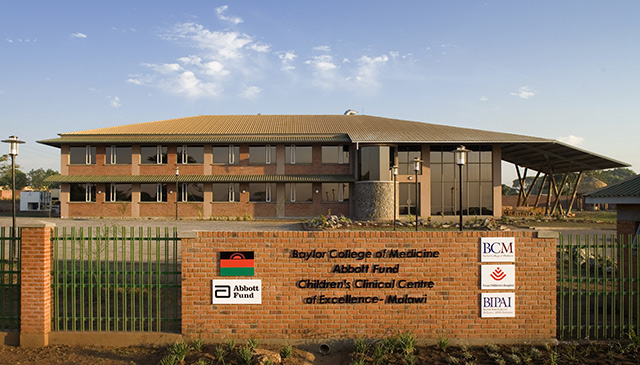
The groundwork for Baylor-Malawi’s operations was laid 14 years ago with the establishment of the Baylor College of Medicine Children’s Foundation-Malawi and the construction of the Baylor College of Medicine-Abbott Fund Children’s Clinical Centre of Excellence (COE) in Lilongwe. The center is part of what is the largest care and treatment network based at an academic institution supporting programs for HIV-infected and -affected children.
Providing care and treatment to nearly 300,000 children, BIPAI has established public-private partnerships in 10 countries across sub-Saharan Africa as well as Latin America and Romania. These partnerships now extend beyond the scope of HIV/AIDS and tackle other conditions in the developing world such as cancer, tuberculosis, malaria, sickle cell and malnutrition.
“The BIPAI network provides a solid framework for some of the best maternal and child health specialists in the world to share best practices and resources in care and treatment, medical education, and clinical and operational research focused on HIV/AIDS, tuberculosis, malaria, malnutrition, neglected tropical diseases and other conditions impacting the health and well-being of children and families worldwide,” said Michael Mizwa, the chief executive officer of BIPAI. “We are always looking for ways to expand the scope and reach of our services, never allowing anything to distract us from our commitment to children and families.”
Created in 1996, the BIPAI network was developed with the goal of improving the health and lives of HIV-infected children and families globally through expanded access to HIV/AIDS care and treatment, capacity building, health professional education and training and clinical research.
With initial support from Houston’s Sisters of Charity of the Incarnate Word, Abbott Fund and AmeriCares, the first center of excellence (COE) in the BIPAI network was created in Romania in 2001. Deaths among children with HIV declined from 15 percent to 1 percent and provided the first proof of concept for providing large-scale HIV treatment to children in a limited resource setting.
The Botswana-Baylor Children’s Clinical COE opened in 2003 with funding through Bristol-Myers Squibb’s Secure the Future program, and treated 1,200 children that year. The model proved to be a success and garnered attention from other governments, leading to centers being established in Lesotho, Eswatini, Malawi, Tanzania and Uganda.
When BIPAI entered Malawi, the country was experiencing an HIV/AIDS epidemic that was ravaging families such as Nyasulu’s. The country had little to no resources to fight the epidemic, misinformation was spreading about the disease and a negative stigma was quickly being attached to those who had HIV/AIDS.
“People were beginning to lose hope,” Nyasulu said. “They couldn’t see how to turn things around.”
A beacon of light
On any given day of the week, the Center of Excellence in Malawi’s capital is a hub of activity from the moment it opens in the early morning until it closes in the late afternoon. Often times, people are scattered across the facility’s lawn before its doors open anxious to get inside and receive the care they need to continue living with HIV/AIDS.
Some are waiting to see one of the center’s clinical workers, visit the center’s pharmacy to pick up medication or talk with a social worker, while others are there to participate in one of the center’s many programs aimed at helping adolescents adhere to their care program.
“Baylor-Malawi is the largest provider of pediatric HIV care and treatment services in the country,” Nyasulu said. “The COE in Lilongwe has an active case-load of more than 3,000 patients with 2,000-plus on medication. The average enrollment is 23 new patients per month. We are a very busy center.”
The center’s team also provides staff to support the pediatric ward at Kamuzu Central Hospital and Area 25 District Health Centre in Lilongwe, works in four busy government health centers in other areas of Lilongwe and performs outreach across the country. The team supplies technical expertise to various HIV technical working groups of the Ministry of Health as they consider various policy issues and management guidelines related to pediatric HIV.
Over the past decade, these efforts have helped make a huge dent in the number of people in Malawi infected and affected by HIV/AIDS. One of those people is Pacharo Mwachitete.
Mwachitete was born with HIV/AIDS and started coming to the Center of Excellence when he was 13. He is now 25 and is a mentor for the center’s Teen Club, one of the center’s various adolescent programs that focus on providing psycho-social and care and treatment support to young people with HIV/AIDS.
“I learned so much from the people I met at the center and through Teen Club,” Mwachitete said. “Without this place and its programs I’m not sure I would be here today.”
Doris Lidamlendo, a 19-year-old Teen Club graduate, agreed and said the skills she learned while in Teen Club taught her how to live with HIV/AIDS. She learned what to do when she was stressed, healthy eating habits, the importance of taking her medicine and more. Most of all, Lidamlendo said she met people like herself.
“Being able to hear how other people like myself have lived with a similar problem has always been a motivation for me,” said Lidamlendo, who recently finished high school and would like to go to college for either civil engineering or social work. “It has made me grow and I am convinced without it you wouldn’t be talking to the girl you are talking to now.”
Judy Lungu is the special projects and training coordinator for Baylor-Malawi and coordinates all of its adolescent programs, including Teen Club, Camp Hope, a Transition Training, Young Mother’s Program and a Teen Support Line. She said the goal of the programs is to teach young people with HIV/AIDS the importance of taking their medication and to convince them that they are not alone in their journey with the disease.
“We believe that for the health of the adolescents to improve and for them to live positively, they must understand that taking their medication is a matter of life and death,” Lungu said, adding that it’s often times easy for a young person who is feeling good and wanting to be more like their non-HIV/AIDS peers to decide to stop taking it. “We also feel it is important for them to know there are people like them who are going through the same thing, and that they are loved and are worthy of being loved.”
The programs Lungu runs are a tremendous success so much so the Malawi Ministry of Health and other partners have embraced the concept and organized similar programs across the country.
For more information about Baylor College of Medicine International Pediatric AIDS Initiative at Texas Children’s Hospital in Malawi, click here. To make a donation to Texas Children’s global health efforts, click here.